Nikolaus Boots

Next week will be time to put out your boot for Nikolaus! Children in Germany put out a boot (not both – you don’t want to seem greedy!) on the eve of December 5th. Oh, and it has to be cleaned first! Nikolaus comes in the night and fills the boot with little treats, like nuts, chocolates, and mandarin oranges.
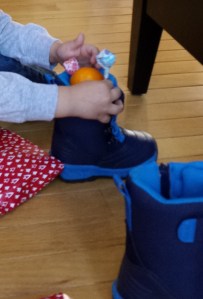
nikolaus-2015-12-06

Our Nikolaus also brought some lollipops and even some holiday pajamas! (Froggy was disappointed not to get a toy. Oh well!)

To help get ready for his visit, we do a Nikolaus craft. Cut a boot out of folded construction paper (red, if you have it), punch holes along the edge, and let your child use yarn to lace it up! We’ll be making these at Story Hour this year, too.

2016-11-28-13-08-00

This year, I thought we would add an extra step: decorating it with stickers and gluing cotton balls to the top for a “fur” lining.

Meanwhile, if you want to try it, you can download the template here in PDF: Boot Lacing

Fold your construction paper in half and place the template over it. Cut out the boot and then punch holes approximately where the dots are. Cut a length of yarn. Put one end through the bottom hole and tape it to the back. Tie a knot in the other end to make it easier to lace the boot.
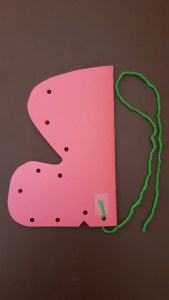
wp-1480775179440.jpg

Here are some of our results from Story Hour. The kids got a little creative! I thought the cotton balls would go across the top. But someone had other ideas. Other children also used crayons to color on their boots.

Let me know how it works out!

Save

Head, Shoulder, Knees, and … Feet!

Today at school, we brought back a favorite lesson from last year: Body Parts! The children loved singing the German version of “Head, Shoulders, Knees, and Toes” – which says Fuß instead of toes 🙂

We started off with the 8 body parts in the song:

  • der Kopf
  • die Schulter
  • das Knie
  • der Fuß
  • die Augen
  • die Ohren
  • die Nase
  • der Mund

Then we got to sing the song! In case you need the German words to the song, it goes like this:

Kopf und Schulter, Knie und Fuß, Knie und Fuß.
Augen, Ohren, Nase, und Mund.
Kopf und Schulter, Knie und Fuß, Knie und Fuß.

We also did the Fingerspiel about the mouse family. (You can find it in my last teaching post: about Counting Mice.) And we read Eric Carle’s Von Kopf bis Fuß (Gerstenberg, 2011).

von-kopf-bis-fus

Finally, the children got to do a coloring page I created with all those body parts they learned at the beginning of the lesson:

kopf-schulter-knie-fus-malvorlage-gita

Download the coloring page in PDF here: Kopf Schulter Knie Fuß Malvorlage GitA

Montags mit Mama: Presents!

Hippo is really getting into the Christmas spirit! We put up our trees (yes, we have two! One with just ball ornaments in silver and red, one with all our special ornaments we’ve collected over the years), and now he wants to start putting presents under them! So he and AP3 have been “wrapping” presents!

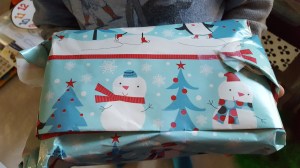
He found a small empty box, filled it with some shape beanbags. Why? I don’t know! That’s just what he thought should go in the box! And then he and AP3 wrapped the box in some old Christmas paper.

2016-11-28-12-54-44

Is it perfect? Of course not! But he had so much fun! He was so happy to bring it to me as I’m working in my office (try not to look at the mess behind him!). And after I unwrapped his Geschenk, he wanted to do it all over again! I think they rewrapped the “gift” 3 times!

You don’t need anything special. Just grab an empty box, some old wrapping paper, tape, and whatever your little one wants to put in the box. Turn on the holiday music, and have some fun!

What a simple activity to do during the holidays!

Learning Vocabulary with an Adventskalender (Advent Calendar)

Years ago when I was teaching at a German Saturday school, I wanted a fun way for my students to learns some Christmas vocabulary. I remembered making a paper chain advent calendar as a child and thought I could combine the two into a fun activity. For the past few years, I’ve been working on creating something similar for my kids. This new version includes printed stickers (that you make using round labels). Froggy has enjoyed it for the past few years. And now Hippo is old enough to get in on the action. I have the words printed on two different papers, so there won’t be any arguing over whose turn it is to do the calendar!


Here’s more on how it works:

Materials:

  • round white labels, 1 2/3 inches in diameter (compatible with Avery 5293)
  • white card stock, 2 pieces
  • tape
  • scissors or craft (X-ACTO) knife
  • letter-sized paper in holiday print, red and green, or whatever pattern/color you like, 2 pieces (I have a stack of 12×12 holiday crafting paper, and I just cut it down to size: 8½ x 11)
  • glue/tape/stapler

Instructions:

  1. Print the stickers on the round labels.
  2. Choose which version you want and print out the Adventskalender on the card stock.
  3. Tape the two pages together to make one long page.
  4. Carefully cut slits in the bottom page along the two black lines. (You can use an exacto knife or the blade of a pair of scissors.)
  5. Print the chain vocabulary words on patterned/colored letter-sized paper. *If using patterned paper, be sure to print on the back (white) side!
  6. Cut out the vocabulary words. A paper-cutter comes in handy here! Don’t worry if it’s not perfect. You won’t really see the lines!
  7. Begin making your paper chain, securing your loops with glue, tape, or a stapler. Be sure to save one strip to attach the chain to the Adventskalender. Be sure the word is on the inside and the decorative side is facing out! You can put them in random order or in alphabetical order (like the Adventskalender). Slip the last strip through the slits you made in the bottom of the Adventskalender and then through the first loop on your chain.

Hang up your Adventskalender! I like to use double-sided poster tape. Each day, have your child take off one strip. Copy the word onto the black space (if using the version without words). And match the sticker to the word!

I used to hang ours on the outside of the pantry door in the kitchen. But this year, I hung it up in the dining room next to our German calendar. I like that the kids can see it while they are eating at the table.

2016-11-27-11-29-00

Download all the materials in PDF here:

Stay tuned for a fun craft to celebrate Nikolaus!

Save

So Many Vehicles!

Today in Story Hour, we read and sang about vehicles … cars, buses, trains, excavators, fire trucks, tractors, submarines, ships, hot air balloons, rockets, and even soapbox cars!

After reading our books, singing our songs, and doing a finger play, the children created their own little book based on Kikaninchen: Wer fährt heute mit? Each child had a booklet with each of the days and a place to enter which vehicle was used and who got to go along. They could fill in the information (with help from a caregiver) and then add the appropriate sticker to match. Later on, when Froggy (our 7-year-old) heard about the project, he wanted to do one, too. He was able to write the words himself, with some spelling help. Here are two examples:

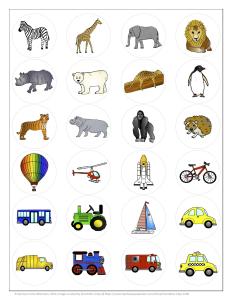
To assemble the booklet, you print out the two pages, double-sided, and cut them in half. Then you can staple them together to make the booklet. (You’ll need a long reach stapler to get all the way to the middle of the booklet.) Next, print out the stickers on round labels (1 2/3-inch):

wer-fahrt-heute-mit-stickers-gita-docx-page-001

You can download both documents here in PDF format. Included in the download is a sheet with specific instructions.

The three books we read were:

  • Unser Ausflug. Wir fahren ins Grüne  by Chris Embleton & Louise Martin (Parragon, 2008)
  • So viele Fahrzeuge im Einsatz  by Stefan Seidel (Coppenrath, 2011)
  • Kikaninchen: Wer fährt heute mit?  (arsEdition, 2011)

We also did a fingerplay (Fingerspiel): “Tatütata(click on the link to see a video of the fingerplay)

Tatütata – Wer kommt daher?
Tatütata – die Feuerwehr.
Tatütata – Es brennt ein Haus.
Tatütata – die Schläuche raus.

Wasser marsch!

And we sang two songs:

“Die Räder vom Bus”

Die Räder vom Bus, die rollen dahin, rollen dahin, rollen dahin
Die Räder vom Bus, die rollen dahin
Stundenlang

Die Türen vom Bus gehen auf und zu …

Die Wischer vom Bus machen wisch wisch wisch …

Die Hupe vom Bus macht “tut tut tut” …

Der Fahrer vom Bus sagt: “Fahrkarte, bitte!” …

Die Kinder im Bus machen “Blah blah blah” …

Die Leute im Bus, die schaukeln hin und her …

“Mit der Eisenbahn” (2010, von Ottmar Liedl)

Wir fahren heute Eisenbahn
und schauen uns die Welt mal an
Wir machen einen langen Zug
Platz für alle ist genug

Hallo, Du! Du bist dran!
Hallo, Du! Häng dich dran!
Mach die Türe zu
Der Zug, der fährt jetzt ab

Wir fahren heute Eisenbahn
und schauen uns die Welt mal an
Wir fahren jetzt in eine Stadt,
die den Namen Passau hat

Hallo, Du! Du bist dran!
Hallo, Du! Häng dich dran!
Mach die Türe zu
Der Zug, der fährt jetzt ab

Wir fahren heute Eisenbahn
und schauen uns die Welt mal an
Wir fahren bis zur Endstation
Da ist die schon

Save

Counting Mice

This week in the Pre-K/Kindergarten class, we are focusing on numbers. The children have already been exposed to a few numbers. When we sing the Hello Song, I always say “eins, zwei” when they clap, or pat their legs, or especially when they stomp their feet, so that they don’t get carried away with the actions. It’s also a nice way to reinforce the first two numbers.

Today, we are adding the next three numbers. We will go over the numbers 1 through 5 using the number cards I made last year:

You can download the PDF file here: 1-5-farm-animals-gita

Then we’ll sing a song from our very first lesson this year. Now that I am going in to teach every week, I really want to bring back the songs and books throughout the year to reinforce the lessons for the children. So we’ll sing “Meine Finger, Meine Finger” from Die 30 Besten Spiel- und Bewegungslieder 3. There is no counting in the song, but we will do the different movements five times and count as we do.

I will also do a finger play called Die Mausfamilie. Again, there is no counting, but you use all 5 fingers to represent the family members. I did this finger play in class last year, and the children really enjoyed it.


die-mausfamilie-fingerspiel-w-translation-page-001

You can download the PDF here: die-mausfamilie-fingerspiel-w-translation

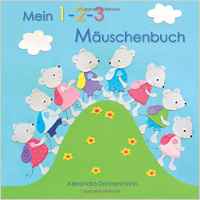
Finally, we will read the book Mein 1-2-3 Mäuschenbuch by Alexandra Dannenmann.

mein-1-2-3-mauschenbuch

This book is available from both Amazon.de and Amazon.com.

I’ll send the children home with a coloring page with 5 little mice.

zahlen-1-5-mause-gita-page-001

Download the PDF here: zahlen-1-5-mause-gita

Save

A Little More for “Martinstag”

I was in the Pre-K/Kindergarten class today. I just love sharing the stories of St. Martin with the children. In a Montessori-based school where the principles of peace and respect are not only taught, but practiced on a daily basis, the kindness and generosity of the St. Martin story fit in beautifully.

This year, I had a new tool for telling the story. I ordered a set of Bildkarten (picture cards) called St. Martin feiern mit Emma und Paul – Bildkarten für unser Erzähltheater. The cards are nice and big (DIN-A3: 11.7 x 16.5 inches), and the images are simple and clear. I didn’t use all of the cards, but chose a few to talk about Martin cutting his cloak in two to share with the beggar, the children crafting lanterns and then parading at night in the town square. There are also some images to show Paul dropping his Martinsmann cookie and Emma breaking her own cookie in two to share with Paul. Very sweet!

The books I have for Martinstag have quite a bit of text. They work fine for story hour, where the children come from German-speaking families. However, I really liked the format of having large pictures to show while I explained the story, simply and in English.

martinstag-bildkarten

After teaching the words to “Laterne, Laterne,” the children made their paper lanterns – with some help from the two teachers and myself. We were glad to have some tape on hand, as a few of the children didn’t quite get the instruction not to cut all the way through! One of the teachers gave the useful tip that cutting the strips in the lanterns is very much like cutting fringe – a work they do regularly in the classroom.

As the children finished their lanterns, they took a seat on the rug until everyone was finished. Then we sang the song as we paraded through the classroom and out into the hall. The principal and several other staff members came out to see where the singing was coming from. She said it sounded like little angels!

If you missed the post on the lantern instructions or the vocabulary cards to help teach the song, click here to go back and take a look!

How do you help the children celebrate Martinstag? I’d love to hear!

Der gute Martin

Next week marks the celebration of St. Martin’s Day. I have to admit, while I lived in Germany, I never actually witnessed the children walking through the streets with their homemade lanterns on November 11th. I didn’t know about the special day until I was teaching in the States at a German Saturday School. It’s such a sweet celebration, though! Now I love to share it with the children at Story Hour and in Preschool.

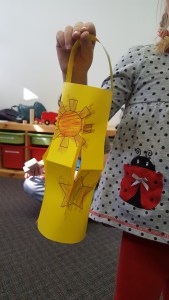
To go along with the celebration, I have created a very simple lantern for the children to make. You can print it out, let them color the paper if they like, and then cut along the dotted lines and assemble it. You can download the template and instructions in PDF format here: martinstag-laterne

2016-11-04-11-10-34

A finished lantern from Story Hour

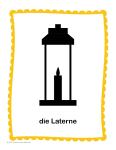
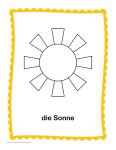
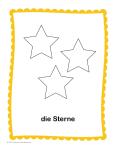
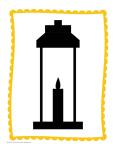
The songs that go with Martinstag are also very important. We always sing two of the most popular ones at Story Hour: “Laterne, Laterne” and “Ich geh’ mit meiner Laterne.” When I teach Preschool, I often just do the first two lines of “Laterne, Laterne,” since it is easy to learn and helps the children learn some of the more important vocabulary words: Laterne, Sonne, Mond, and Sterne. To teach the songs, I made up some vocabulary posters of these four words, a coloring page, and a sheet with the lyrics. You can download all of them in PDF format here:


Here’s an idea of what they look like:

When I teach Martinstag at Story Hour, I include several books. I have a few about Martinstag itself. This year, we’ll be reading Laterne, Laterne, da oben leuchten die Sterne by Dagmar Geisler and Rosemarie Künzler-Behncke (Ravensburger, 2009). I also like to read the fairy tale “Sterntaler” about the little girl who gives away all her earthly possessions to others in need and is rewarded in the end with a shower of coins that fall from the stars to last her the rest of her life. (I actually made my own book of this fairy tale, so I don’t have one to recommend here.) This year, I’m adding a beautiful new book (well, new to me!) called Der rote Faden by Anne-Gaëlle Balpe and illustrated by Eve Tharlet (Minedition, 2014). In this story, little Oli finds a red thread and by passing it on, he learns how little it takes to help others.

Save