Counting Mice

This week in the Pre-K/Kindergarten class, we are focusing on numbers. The children have already been exposed to a few numbers. When we sing the Hello Song, I always say “eins, zwei” when they clap, or pat their legs, or especially when they stomp their feet, so that they don’t get carried away with the actions. It’s also a nice way to reinforce the first two numbers.

Today, we are adding the next three numbers. We will go over the numbers 1 through 5 using the number cards I made last year:

You can download the PDF file here: 1-5-farm-animals-gita

Then we’ll sing a song from our very first lesson this year. Now that I am going in to teach every week, I really want to bring back the songs and books throughout the year to reinforce the lessons for the children. So we’ll sing “Meine Finger, Meine Finger” from Die 30 Besten Spiel- und Bewegungslieder 3. There is no counting in the song, but we will do the different movements five times and count as we do.

I will also do a finger play called Die Mausfamilie. Again, there is no counting, but you use all 5 fingers to represent the family members. I did this finger play in class last year, and the children really enjoyed it.


die-mausfamilie-fingerspiel-w-translation-page-001

You can download the PDF here: die-mausfamilie-fingerspiel-w-translation

Finally, we will read the book Mein 1-2-3 Mäuschenbuch by Alexandra Dannenmann.
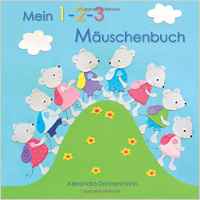
mein-1-2-3-mauschenbuch

This book is available from both Amazon.de and Amazon.com.

I’ll send the children home with a coloring page with 5 little mice.

zahlen-1-5-mause-gita-page-001

Download the PDF here: zahlen-1-5-mause-gita

Save

A Little More for “Martinstag”

I was in the Pre-K/Kindergarten class today. I just love sharing the stories of St. Martin with the children. In a Montessori-based school where the principles of peace and respect are not only taught, but practiced on a daily basis, the kindness and generosity of the St. Martin story fit in beautifully.

This year, I had a new tool for telling the story. I ordered a set of Bildkarten (picture cards) called St. Martin feiern mit Emma und Paul – Bildkarten für unser Erzähltheater. The cards are nice and big (DIN-A3: 11.7 x 16.5 inches), and the images are simple and clear. I didn’t use all of the cards, but chose a few to talk about Martin cutting his cloak in two to share with the beggar, the children crafting lanterns and then parading at night in the town square. There are also some images to show Paul dropping his Martinsmann cookie and Emma breaking her own cookie in two to share with Paul. Very sweet!

The books I have for Martinstag have quite a bit of text. They work fine for story hour, where the children come from German-speaking families. However, I really liked the format of having large pictures to show while I explained the story, simply and in English.

martinstag-bildkarten

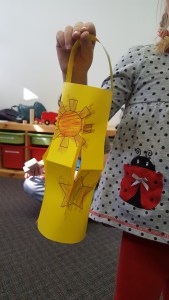
After teaching the words to “Laterne, Laterne,” the children made their paper lanterns – with some help from the two teachers and myself. We were glad to have some tape on hand, as a few of the children didn’t quite get the instruction not to cut all the way through! One of the teachers gave the useful tip that cutting the strips in the lanterns is very much like cutting fringe – a work they do regularly in the classroom.

As the children finished their lanterns, they took a seat on the rug until everyone was finished. Then we sang the song as we paraded through the classroom and out into the hall. The principal and several other staff members came out to see where the singing was coming from. She said it sounded like little angels!

If you missed the post on the lantern instructions or the vocabulary cards to help teach the song, click here to go back and take a look!

How do you help the children celebrate Martinstag? I’d love to hear!

Der gute Martin

Next week marks the celebration of St. Martin’s Day. I have to admit, while I lived in Germany, I never actually witnessed the children walking through the streets with their homemade lanterns on November 11th. I didn’t know about the special day until I was teaching in the States at a German Saturday School. It’s such a sweet celebration, though! Now I love to share it with the children at Story Hour and in Preschool.

To go along with the celebration, I have created a very simple lantern for the children to make. You can print it out, let them color the paper if they like, and then cut along the dotted lines and assemble it. You can download the template and instructions in PDF format here: martinstag-laterne

2016-11-04-11-10-34

A finished lantern from Story Hour

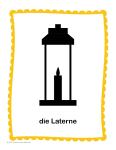
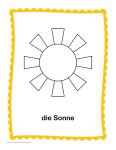
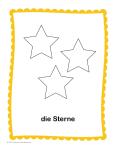
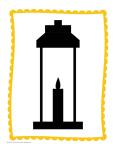
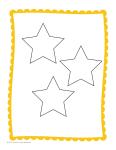
The songs that go with Martinstag are also very important. We always sing two of the most popular ones at Story Hour: “Laterne, Laterne” and “Ich geh’ mit meiner Laterne.” When I teach Preschool, I often just do the first two lines of “Laterne, Laterne,” since it is easy to learn and helps the children learn some of the more important vocabulary words: Laterne, Sonne, Mond, and Sterne. To teach the songs, I made up some vocabulary posters of these four words, a coloring page, and a sheet with the lyrics. You can download all of them in PDF format here:


Here’s an idea of what they look like:

When I teach Martinstag at Story Hour, I include several books. I have a few about Martinstag itself. This year, we’ll be reading Laterne, Laterne, da oben leuchten die Sterne by Dagmar Geisler and Rosemarie Künzler-Behncke (Ravensburger, 2009). I also like to read the fairy tale “Sterntaler” about the little girl who gives away all her earthly possessions to others in need and is rewarded in the end with a shower of coins that fall from the stars to last her the rest of her life. (I actually made my own book of this fairy tale, so I don’t have one to recommend here.) This year, I’m adding a beautiful new book (well, new to me!) called Der rote Faden by Anne-Gaëlle Balpe and illustrated by Eve Tharlet (Minedition, 2014). In this story, little Oli finds a red thread and by passing it on, he learns how little it takes to help others.

Save

Halloween & die kleine Hexe

When I teach German at preschool around Halloween, I like to do a lesson on colors to go with the song, “Ich bin die kleine Hexe”. First we review a few colors. Then we sing the song to practice the colors. At this point in the year, we’re starting with the basics: just the primary colors of red, yellow, and blue.

I created a full-sized poster of a pair of shoes and printed them on red, yellow, and blue paper to use as a cue when we sing the song.

schuhe-kleine-hexe-gita-page-001

There is also a coloring page with three sets of shoes, one for each color. The lyrics are on the sheet as well, so the children can bring them home with them. I often hear from parents about how the children sing the songs I teach them, but they don’t know the songs! So I hope this helps them out.

schuhe-malvorlage-gita-page-001

You can download them each here as PDF:

You can also find the sheet music here at Labbe.

Happy Halloween!

Zoo Animals

Today, I’m taking my zoo theme to Froggy’s school for their lesson.

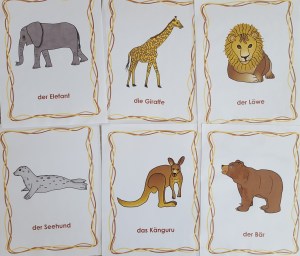
First, I created some word posters to teach the children some of the animal names.

  • der Bär
  • der Elefant
  • die Giraffe
  • das Känguru
  • der Löwe
  • der Seehund

You can download them here: Zootiere Posters (PDF)

2016-05-25 11.45.20

We will then sing “Unser kleiner Bär im Zoo” from Die 30 besten Sing- und Bewegungslieder. In an effort to keep the kids a little calmer and quieter, we’re going to change the words. Our bear is going to nicken (nod his head), winken (wave), and klatschen (clap). I have to admit, it’s also easier to sing when you don’t have to jump and stomp and dance around!

index

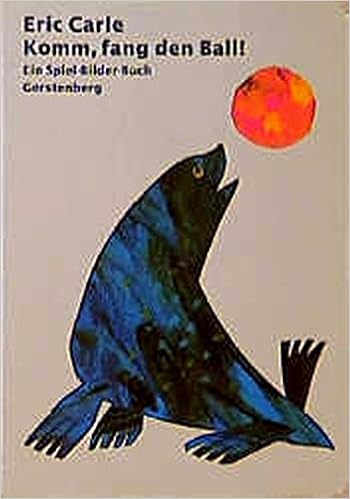
After that, I’ll read another Eric Carle book, called Komm, fang den Ball! (Gerstenberg, 1999) This book has a flat, circular cut-out that acts as the ball. It’s attached to a string that pulls through the whole book, so that each animal can “throw” the ball to another animal.

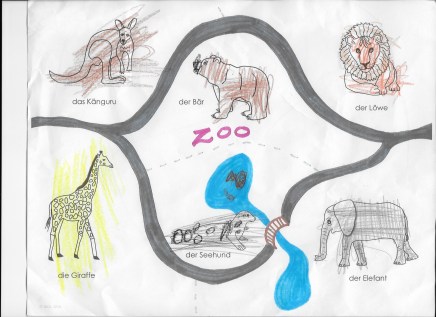
Finally, I updated the zoo map I made for story hour to be a coloring page. You can download that, too: Zoo Karte Malvorlage (PDF) Here’s Froggy’s example (he’s more into fast than neat coloring these days 🙂 )

Zoo Karte AMR GitA

Save

Spiders on the Farm

Today, I’ll be teaching a lesson based on Eric Carle’s book, Die kleine Spinne spinnt und schweigt.

First, we will review the five farm animals they learned when we read Klingelingeling:

  • die Katze
  • der Hund,
  • das Schwein
  • die Ente
  • das Pferd

Then I’ll use more images to introduce the other animals (and insect!) in the story:

  • die Kuh
  • das Schaf
  • die Ziege
  • der Hahn
  • die Eule
  • die Spinne

For the images, I found Eric Carle’s images in a bulletin board set on Amazon. (Nope, I don’t get compensation for mentioning this product! 🙂 )

We will also talk about the different sounds the animals make in German.

Next we sing “Die winzig kleine Spinne.” There are several German versions, including one called “Imse Bimse Spinne.” But this is the one that I know:

Die winzig kleine Spinne
kroch auf den Wasserhahn.
Dann kam der Regen
und ward sie aus der Bahn!
Dann kam die Sonne
und trocknet wieder auf.
Und die winzig kleine Spinne
kroch wiederum hinauf!

Finally, I will read the book to the children. I love to be dramatic when reading books to children 🙂  So I exaggerate the animal sounds and read in voices that sound like the various animals.

I always try to bring a craft or a coloring page for the children. This week, I’ll bring a coloring page with the six new animals on one side and the words to the song on the other. Here you can download a copy of the coloring sheet, which includes an extra page with the first five animals as well: Malvorlage kleine Spinne (PDF)

kleine Raupe

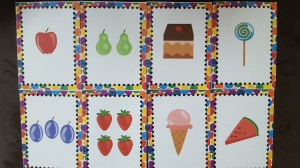
We have loved Eric Carle’s book about the hungry caterpillar for years! I wanted to share it with Froggy’s class last week. So I created some picture cards to introduce the words. For this set, I added cards with words and numbers, too.

Included in this set are:

  • image cards
  • images with numbers, 1-5
  • images with words (fruit in both singular and plural)
  • words only

2016-05-10 19.23.12

Print them full-size for wall posters or to have large images to introduce to a class. Or print them 6-to-a-page for flashcards or a memory or matching game.

If you want to use them for Memory, be sure to use a thicker cardstock, so that the images don’t show through 🙂

I’d love to hear how you use the cards!

Click here to download: kleine Raupe Posters  (PDF file)

In addition to the posters, there is also a coloring page with the caterpillar and the five different fruits, labeled with colors and numbers. Download here: kleine Raupe Essen Farben Zahlen Malvorlage (PDF file)


Save

Head, Shoulders, Knees and Toes

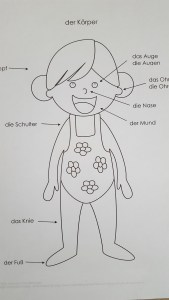
To go along with the latest theme on Body Parts, I also created a coloring page to accompany the song “Kopf und Schulter, Knee und Fuß”.

2016-04-25 14.56.04

Kopf Schulter Knie Fuß Malvorlage (PDF)

In case you need the German words to the song, it goes like this:

Kopf und Schulter, Knie und Fuß, Knie und Fuß.
Augen, Ohren, Nase, und Mund.
Kopf und Schulter, Knie und Fuß, Knie und Fuß.


Easter Counting

Okay, I’m a little late on these Easter activities. But maybe you can squeeze them in now. Or mark them for next year!

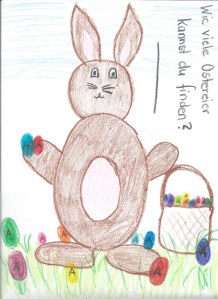
#1: Wie viele Ostereier kannst du finden?

The first activity is a drawing by Lisa (our first au pair from Germany) in which the child counts the Easter eggs. Click the link to download the PDF file:

Wie viele Ostereier kannst du finden – Lisa

It looks like this:

Wie viele Ostereier kannst du finden - Lisa

#2: Malen nach Zahlen: das Osterei

Then there is a simple color by number I created for the school children. It has more to do with number recognition than counting. Click the link to download the PDF file:

Osterei Malen nach Zahlen

Osterei Malen nach Zahlen image

#3: Number flashcards 6 – 10

I also created some large cards for the numbers 6 through 10. (I have 1-5 to go with a farm unit.) You can print them as full 8.5 x 11 or set your printer to print 2 or 4 to a page and then cut them up. I like to laminate the pages, but you could also print them on card stock. Click the link to download the PDF file:

6-10 Ostern

Frohe Ostern!