Activities to help your little ones learn German one afternoon at a time * Tales from my German classroom * Plus a sprinkle of travel adventures thrown in!
I have been working hard to create the rest of the pages for our unit on hedgehogs in 1st & 2nd grade. And I think they are finally finished!
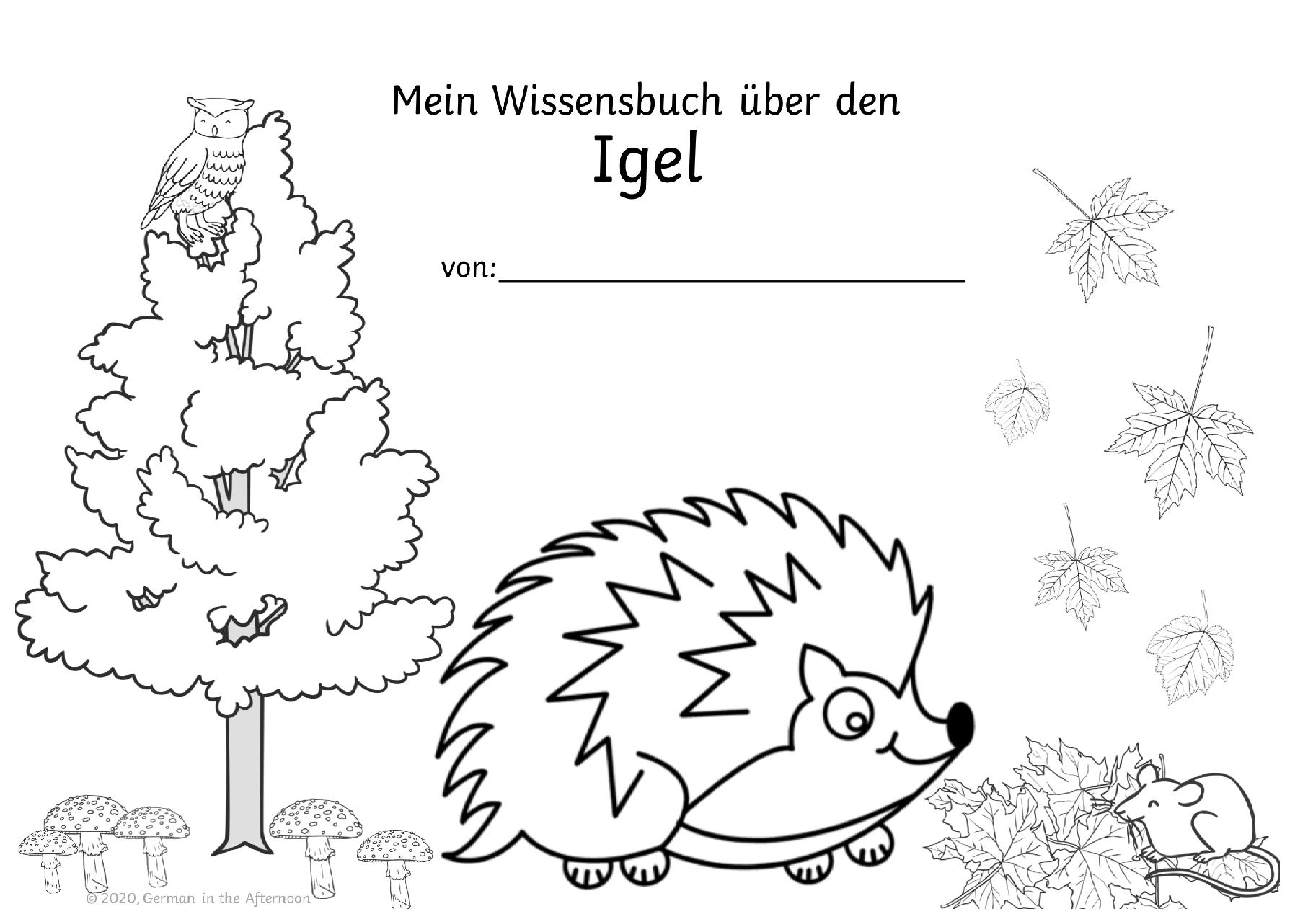
I made two different cover pages. I think I will use the simple one and give instructions in German on which colors to color each element:
Die Stacheln des Igels sind dunkelbraun.
Das Körper und das Gesicht des Igels sind hellbraun.
Die Eule ist grau.
Der Pilz ist lila.
Das Blatt oben ist rot.
Das Blatt in der Mitte ist orange.
Das Blatt unten ist gelb.
We will do the cover page on the last day of the unit. There are three other pages (Habitat, Feinde, Essen). We will do one page per week.
The entire hedgehog unit will take us 6 weeks to complete. (We’ve already labeled the body parts and talked about where in the world hedgehogs live.)
Each week I also show the children an adorable picture of Mr. Herbee, the Hedgehog. Do you know him? He’s an Instagram sensation! He is the second hedgehog pet of a woman in Wiesbaden. The kids just love seeing his happy little face every week!
(Note that the program I used to make the worksheets creates for A4 paper. Just make sure you tell your printer to fit to letter size, if you are printing in the US!)
For our first lesson on the hedgehog in 1st & 2nd grade, I found a simple labeling project for the kids. I got it from Zaubereinmaleins.
I decided to leave mine as a full page, since I’m only using one of her pages from this Igelheft. Before we did the labeling, we reviewed some body parts in German and then sang “Kopf, Schulter, Knie und Fuß“. It was a nice opportunity to get the kids moving, too.
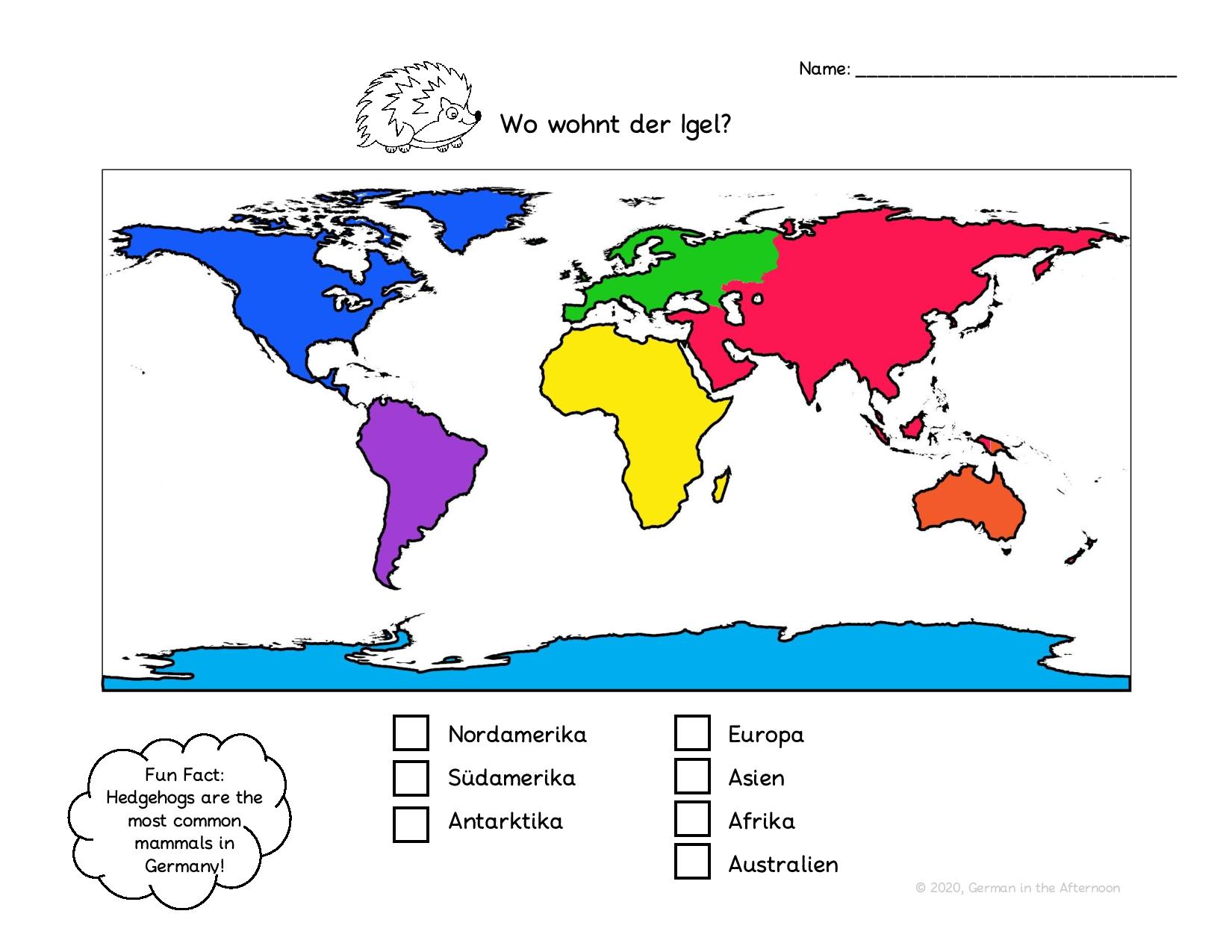
Next week, I want to talk about where in the world you can find hedgehogs. As I mentioned in my last post, they are the most common mammals in Germany. Yet they are not indigenous to North America! So I created a worksheet for the kids to label on which continents hedgehogs live. I decided my first version was too difficult for little hands to color, so I ended up making two versions. One where they just color the matching box to “check it off” and one where they could color in the continents.
For the second worksheet, the kids can just check off the continents. Or they can also color them in. They could even be challenged first to see if they can color in Germany in a different color.
I found this image on Junior.de to use as my guide:
We’re back!! Our school opened before Labor Day, and I’m so proud of the work that everyone in the building has done to make it safe for our children. For the first few weeks, only the younger children are in the building: pre-k through 2nd grade. Hopefully the big kids will be able to get away from their screens and be back in the building next week.
Because of all the new COVID protocols, specials teachers are going into the classrooms, so as to keep the children in their “pods”. There is also less movement throughout the school that way. For me, it means that I now will be teaching two grades at once. (I’m at a Montessori school, and one of the beautiful parts about it is that the children are in multi-grade classrooms.)
While teaching two grades at once could be a challenge (although so far, so good!), it also presents a new opportunity. Instead of getting each grade for 30 minutes, I have the whole class for about 50 minutes. So in addition to teaching German through Story Listening, I’m able to add in some culture, too!
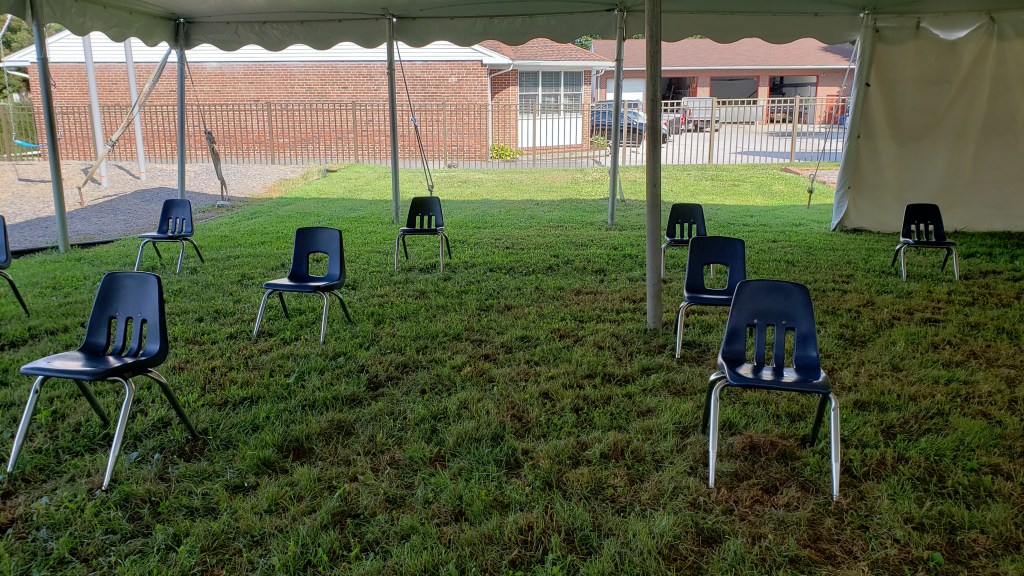
My prek-k/kindergarten classes have not changed too much. Except that I am teaching them outside under a tent! We have the chairs spaced well apart, and I spray them clean in between classes. I use a face shield, so they can see my face, and the children wear masks (I truly hope they won’t have to for long!). The biggest challenge is hearing them and recognizing them! My shield also creates a weird echo for me, so I do come home with a headache each week. But it’s wonderful to see the children! We can still sing songs and read stories. And since we have more room outside, we can even be a bit bigger with our movements and our volume!
The first week, the back flap was open, so we did have some distractions from the trucks next door! But the second week, we had more privacy and a quieter outdoor space.
In 1st & 2nd grade, I begin the class by washing my hands. Since we’re supposed to do this for 20 seconds, I have the kids count to 20 with me in German! It’s great! Maybe after they get those down, we’ll try counting backwards. Or count 21 – 40!
Then I was inspired by the morning meeting the class has every day. (Listening in to Hippo’s virtual learning last spring gave me the idea!) First we go over the date in German. I made a sign that I laminated, so I can fill in the day, date, and month with dry-erase marker. Then we talk about the weather. Every day in their class, they go over the temperature (high, low & differential), the wind, the precipitation, and a description. That’s a lot! So we are starting with just the description. They already stumped me this week when they said it was hazy. I’m going to have to look that one up!
Next comes our story. I love to start this group with the story Danke, Bear! by Greg Foley. It’s such a sweet, short, repetitive story. And it’s so easy to adapt. On the first day, I told it about bear who finds a box for his friend the mouse. Along the way to find the mouse, he encounters a rabbit, a frog, and a hedgehog, who all think the box is igittigitt! But he knows it is perfekt for the mouse. And indeed, it is! The second week, I tell it as an elephant who finds a red box for his friend, the green snake. He encounters a lion, a zebra, and a parrot. Next week, I’m thinking about a turtle who finds a shell for his friend, the crab….
After Story Listening, the children work on their very own picture dictionary. I made them for the kids over the summer. Each week, I teach them (mostly in German) how to draw one word from the story. Then they write the German word under it.
For our cultural theme, I don’t have a whole lot of time. So we’re going to spread our learning unit out over about 5 weeks to start. I decided to do some lessons on the hedgehog. Not only are they super cute! But I learned that they are the most common mammal in Germany, while they are not indigenous to the US at all! Read my next post to see what we’re learning about hedgehogs!






 German in the Afternoon Activities