Martinstag in the Classroom: Part 1

As I mentioned in a recent post, I love teaching about Martinstag, because it embodies the spirit of giving and selflessness. In the past, I’ve taught about Martin in the German story hour and in the pre-k/kindergarten class. This year I finally got to bring it into the 1st and 2nd grade class. Each class is a little bit different. In this post I’ll tell you about what we do …

in Story Hour…

We read a couple of books, sing the traditional songs, and make paper lanterns. Then we get to parade through the library. This year, we even got to go into the bank next door! To read more about the books and songs, you can check out the story hour blog. They were all so proud of their lanterns:

2017-11-03 Martinstag post

I often like to tell the fairy tale of the Sterntaler. It’s the story of a little girl who is alone in the world and has next to nothing. And still, she gives away everything she does have. In the end, the stars fall from the sky and become gold coins, and she is wearing a beautiful new slip of the finest material. I usually read a little book about it, but this year, I chose to tell it as a story using the Story Listening method. Here is what my board looked like when I was finished:

2017-11-03 11.26.58

I wasn’t sure how the method would work in a room full of children who already know so much German – not to mention their German-speaking parents! But the children were mesmerized! And the parents really enjoyed it, too!

The next post on 1st and 2nd grade is coming…

Viel Spaß!


Martinstag Lanterns

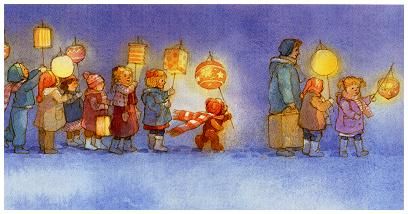
Every year I like to share the celebration of St. Martin with the children I teach – in the story hour, in the pre-K/kindergarten class, and now in the 1/2 class I’m working with. It’s such a wonderful celebration of the spirit of giving.

Every year we make a simple paper lantern. This year, I learned a few things to make the project even better 🙂 Here are the children from Lesestunde with their lanterns:

2017-11-03 Martinstag postJust look at those smiling faces 😉

And here is what the template for the lantern looks like (front & back):

  1. Cut the long strip off the left side to save for the handle (follow the long line on the “back” image)
  2. Color the front – the sun, moon, and stars
  3. Turn to the back and fold the paper along the dotted line
  4. Cut “fringe” along the other dotted lines – stopping at the hash mark at the end
  5. Unfold the paper – fold it back the other way
  6. Wrap the paper to make the lantern, staple at the bottom, staple at the top along with the handle

First, I decided to get out my paper cutter and cut the handles off for the children. Having to first cut a whole strip off the paper and then make fringe seemed rather confusing. This way, they only have to worry about the fringe. It worked great!

Sedond, I am learning to give better – clearer – instructions! You would think this would be obvious. But it’s something you really have to think about! So I had Hippo help me make samples of our Laternen – one for every step (color, fold & fringe, unfold):

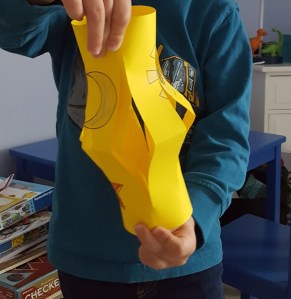
When I went in to his class, I had the samples all ready. So I could easily demonstrate the steps to the children. I showed them a colored paper. Then I showed them how to fold it. I had one folded already with one line of fringe cut. Then I showed them how to cut along the dotted lines to cut the rest of the fringe. That’s basically all they needed to do. We had four adults for 20 children in the room (I brought AP4 with me – another great idea!), so we each had a table of 5 children to help. When they were finished with their three steps, we folded the paper into the lantern shape and stapled on the handles. It was the most successful lesson I’ve ever taught for Martinstag!

2017-11-06 09.09.12 - Copy

See how the lantern “poofs” when you fold the the paper back on itself in the middle after you cut the fringe?

To download the instructions and template for the lanterns, click here: Martinstag Laterne (GitA)

For other materials, see my posts from previous years:

Viel Spaß beim basteln!

Halloween in der Lesestunde

We celebrate Halloween a little early in story hour last week! I don’t think the children minded 🙂

We actually read four books, because I just couldn’t decide on three!

  • Die neugierige kleine Hexe by Lieve Baeten (Oetinger, 2003)
  • Pip und Posy: Das Gruselmonster by Axel Scheffler (Carlsen, 2015)
  • Für Hund und Katz ist auch noch Platz by Axel Scheffler (Beltz & Gelberg, 2017)
  • Wir sind Dreieck, Kreis, Quadrat by Felicitas Horstschäfer (Velber, 2012)

Why did we read a song about shapes that has nothing to do with Halloween?? Read on! You’ll see… 🙂

And of course we sang songs:

  • “Morgens früh um sechs”
  • “Ich bin die kleine Hexe” from Die 30 Besten Spiel- und Bewegungslieder
  • “Die winzig kleine Spinne”

To introduce “Morgens früh um sechs” I brought in a large cardboard clock. We didn’t focus on telling time – the children are much too young for that. But I used it to count up to 12. When we sang “kleine Hexe” we just had to ride our brooms around the room! And we used the colors of the children’s shoes to decide which colors the witch was wearing in the songs. And we went around 7 times – one for each child! For “kleine Spinne” we didn’t just sing about an itsy-bitsy spider. We also sang about a great big spider! Download the lyrics below for the other version.

You can download the lyrics here: Lieder Halloween GitA

We ended with a pumpkin craft. I found orange paper plates (at Target) to be our pumpkins. To make the faces, we used … what else? SHAPES! In the past I have used craft punches to make triangles, circles, and squares out of black paper. Then the children glued the shapes to the pumpkins. This year, however, I happened to find a box of foam shape stickers, so I snatched them up! The children had fun choosing their shapes and creating their pumpkins!

How do you celebrate Halloween … German-style?

Viel Spaß!

Happy Birthday!

Finally I’m getting to cover a topic in our preschool class that I’ve been wanting to do for some time…  BIRTHDAYS!!

One of the boys in the class had a birthday over the weekend, and he is having his birthday celebration in class in the morning. We’ll have to move our class back a little bit to accommodate the celebration. But it’s such a special event in the school, I don’t mind a bit!

I’m not sure how it is in other Montessori schools, but in our school, birthdays are a big deal in preschool and kindergarten. The whole family is invited to come for a short celebration. First, the children set up a sun with the months around it in the center of the circle. Then the birthday child is brought to the circle by two friends. The parents bring in some pictures of the child – about one from each year – and tells a short story of the child’s life. For each year, the child walks around the sun while holding a small globe of the earth, and everyone sings: “The earth goes around the sun, tra la, the earth goes around the sun! The earth goes around the sun, tra la, another year is done!” The child also presents a small present to the class (a book or some other materials that can be added to the collection of classroom “work”). And then everyone sings Happy Birthday, but with an added verse: “We celebrate your birth – and your place on earth. May the sun, moon, and stars – bring you peace where you are!” It’s so beautiful, I cry every time!

So I was inspired to do a little lesson on German birthdays. After our Begrüßungslied, I thought I’d teach the children how to say how old they are: Ich bin x Jahre alt! They are pretty good at their numbers by now, so it shouldn’t be too difficult.

Then I’ll introduce a few vocabulary words that are important to any birthday celebration:

der Kuchen  ~  das Geschenk  ~  der Papphut  ~  die Luftballons

You can download these word posters here: Herzlichen Glückwunsch Word Posters GitA 2017

I’ll also teach them how to sing “Happy Birthday” in German. We’ll leave out the name to keep it simple:

Zum Geburtstag viel Glück!

Zum Geburtstag viel Glück!

Zum Geburtstag viel Glück!

Zum Geburtstag viel Glück!

I was going to read a book called Der Bär hat Geburtstag by Isabel Pin (Beltz & Gelberg, 2015). It’s about a bear who is worried that none of his other animal friends will come to celebrate his birthday … but of course they all do! I liked the different animals in it, and it also showed the birthday images above (cake, hat, balloons, present).

But in the end, I decided to go with Die Maus, die hat Geburtstag heut by Paul Maar (Oetinger, 1997). It is about all the different animals and they presents they bring to the mouse on his birthday. What I liked about this one for the preschoolers is that it repeats the same text for every animal:

“Die Maus, die hat Geburtstag heut. Gleich kommt Besuch, der sie sehr freut. Welches Tier kommt denn hier und will der Maus was schenken?  …

Nun schau gut hin, nun gib gut Acht: Was hat das Schwein denn mitgebracht?”

You get a hint of the animal who is coming (like the trunk of an Elephant), then turn the page and have a sentence about that animal. Then comes the question of what the animal brought as a present. It doesn’t show all the birthday vocabulary I wanted to introduce, but I think that’s okay. The repetition is more important in this case!

Because we’ll be reading about a mouse, I also will do the Mausfamilie Fingerspiel again. They always love that one!

die-mausfamilie-fingerspiel-w-translation-page-001

Here is the PDF of Die Mausfamilie that you can download: die Mausfamilie Fingerspiel with translation

I always send them home with a coloring page, too!

Herzlichen Glückwunsch zum Geburtstag Malvorlage GitA 2017-page-001

You can download that here: Herzlichen Glückwunsch zum Geburtstag Malvorlage GitA 2017

Herzlichen Glückwunsch!

Valentine Countdown

Recently, two different friends sent me a picture of the same idea: decorating the kids’ doors with Valentine hearts. You hang one up every day for 14 days starting on the first of February. But to make them even more special, you write something you love about your child on each heart. Love that!

Of course, I have to turn this into an opportunity to put a little German in front of the boys! So every night I’ve been putting up a heart with a German sentence about the boys. I write in all caps for Hippo, since he’s still learning letters and not reading yet. Froggy gets regular letters, which show off the capitalized German nouns better! So far, I’ve written the same messages on both doors. They can be a bit competitive! At some point, I might write more specific messages.


Here are some of the messages:

  • Wir haben dich lieb!
  • Ich mag es, wenn du lachst!
  • Du kannst gut tanzen!
  • Du bist ein guter Bruder!
  • Es hat Spaß gemacht, das Spiel mit dir anzuschauen!
  • Du bist sehr lustig!

Update: I just added a picture of the finished door. It’s so colorful! I think we’ll leave the hearts up for a while!

It’s not too late to start! Even if you just do a few, it’s a great idea!

I think I tracked down the blog where my friends found the original picture: it’s called Skip to My Lou.

Have fun with your hearts! Let me know what messages you leave!

Save

Happy New Year! Einen guten Rutsch!

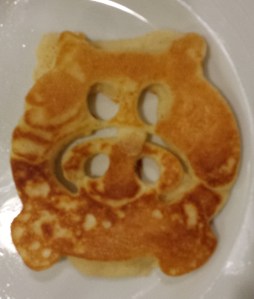
It’s the last day of 2016! How do you celebrate New Year’s? One of the ways to ring in the New Year in Germany is with a Glücksschwein – a lucky pig! It can be made of marzipan or bread. But I’m not skilled enough for either of those 🙂  So in our house, we make pig pancakes!

2015-12-31-17-48-11-1

I ordered the Pig Breakfast Shaper – a silicone pig mold – on Amazon for about $6. Make sure your pancake batter is runny enough to fill out the mold. Then wait until it really sets on the bottom and lift off the mold. Then flip the pancake. Ta-dah! A pig pancake for New Year’s!

img-20161231-wa0000

Jingle Bells

Today in story hour, we were celebrating Christmas! For our last song, we sang “Kling, Glöckchen, Klingelingeling”. But you can’t sing that without some jingle bells, right?! So we crafted our own little jingle bell instruments.

2016-12-16-09-08-39

For the craft, you only need 2 materials: pipe cleaners in two different colors and some jingle bells! Make sure your bells have a large enough hole at the top for stringing the pipe cleaner through.

Instructions:

1. String the jingle bells on to one of the pipe cleaners.

2. Twist the second pipe cleaner around the first one with the jingle bells.

3. Bring the ends together to make a circle. Twist the ends to close the circle. Then tuck the ends around the circle. Remember, pipe cleaners often have a sharp end, so try to tuck those points out of the way as best as you can.

Need the lyrics to the song? You can view or download them here: Weihnachtslieder. Also included are the lyrics for “O Tannenbaum” and “Alle Jahre Wieder.”

If you’re looking for some children’s books about Christmas, we read these three in story hour:

  • Frohe Weihnachten, kleine Tiere (arsEdition, 2015)
  • Weihnachten ist bald (arsEdition, 2010)
  • Wir freuen uns auf Weihnachten (Ravensburger, 2010)

Fröhliche Weihnachten!


Christmas Punch

My very favorite memory from living in Germany is going to the Christmas markets in December. In every town, the market square is transformed into a holiday wonderland. Charming stalls go up from which vendors sell their handmade crafts, food, and drink. It feels like stepping into the magic of Christmas!

I only got to spend two Christmases in Germany. But both times, I made sure to visit as many Christmas markets as I could.

Every town in Germany – as with Austria and Switzerland – has a Weihnachtsmarkt. And every town has its own special Christmas mug. So as you stroll through the wonderland, you can keep warm as you sip your hot drink. For the adults, there is Glühwein, a mulled wine with spices like cinnamon and cloves that is served piping hot. For me it was an acquired taste. But as I made my way from one market to another – Freiburg, Mainz, Worms, Nürnberg, Rothenburg ob der Tauber, Rüdesheim, and Innsbruck, just to name a few – I came to love that warm red wine that tasted like it was flavored with Christmas itself.

As I was only in Germany as an adult, I never bothered to try the children’s version of Glühwein. For them, there is an alcohol-free Kinderpunsch. Since I was visiting Froggy’s 1st & 2nd grade class today to share some of Germany’s Christmas traditions, I decided to bring them some Kinderpunsch. I found a few recipes online and tried them out until I got it right. Of course, I had no idea how it should really taste! So AP3 helped out 🙂  She had never made it herself, but she certainly knew if I’d gotten it right or not.

Here is the recipe that I came up with:

  • 1 liter of fruit tea (I used Celestial Seasonings decaffeinated rooibos pomegranate tea)
  • 1 liter of orange juice
  • 1 liter of grape juice
  • about 1/2 packet (about 5g) of vanilla sugar (I found Dr Oetker’s at my grocery store in the international section. I’ve also bought some from Savory Spice Shop.)
  • 1 tablespoon of honey
  • 2 or 3 cinnamon sticks
  • 3-5 whole cloves
  • 1 small lemon, sliced

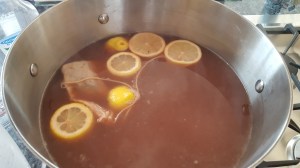
Brew the tea in a pot. Then add the remaining ingredients and heat on low. I put my cinnamon sticks and cloves in a muslin bag, so they would be easy to remove. The longer you let the punch simmer, the more time it has to blend the ingredients. Serve warm and enjoy!

The children had mixed reactions, of course! Some loved it. For others, it was not quite their cup of tea!

2016-12-16-12-14-49

Nikolaus – Free Coloring Page

As we prepare for a visit from Nikolaus, we will be making our lacing boots today in Story Hour. (If you missed that post, you can find it here.)

If you’re looking for something quick and easy, I also made up a coloring page with Nikolaus along with the words to the first verse of “Lasst uns froh und munter sein”.

nikolaus-malvorlage-gita-2015-jpg

You can download the PDF here: Nikolaus Malvorlage GitA

We are expecting some little ones in Story Hour today, so while the older children are lacing and decorating their boots, I thought our young friends could have this picture to color.