Valentine Stories

Yesterday in story hour, we celebrated Valentine’s Day! I always like to focus on friendship when choosing books and songs for the little ones. Here’s what we did:

BOOKS:

  • Alles Freunde by Nele Moost & Annet Rudolph (Esslinger, 2015)
  • “Der Liebesbrief” from Frosch und Kröte by Arnold Lobel (dtv junior, 2008)
  • Frosch ist verliebt by Max Velthuijs (Beltz & Gelberg, 2015)

SONGS:

For lyrics, you can download this PDF document: Lieder zu Valentinstag

  • Ich bin ein dicker Tanzbär (Die 30 besten Spiel- und Bewegungslieder)
  • Der Kuckuck und der Esel (traditional)
  • Wenn du fröhlich bist (version from Die 30 besten Kindergartenlieder)

CRAFT:

This year, we made foam hearts with the word “LIEBE” on them. We used some large foam hearts and put smaller foam heart and letter stickers on them. Then punched a hole and put some yarn through them. Easy, but it gets a little letter practice in, too!

Jingle Bells

Today in story hour, we were celebrating Christmas! For our last song, we sang “Kling, Glöckchen, Klingelingeling”. But you can’t sing that without some jingle bells, right?! So we crafted our own little jingle bell instruments.

2016-12-16-09-08-39

For the craft, you only need 2 materials: pipe cleaners in two different colors and some jingle bells! Make sure your bells have a large enough hole at the top for stringing the pipe cleaner through.

Instructions:

1. String the jingle bells on to one of the pipe cleaners.

2. Twist the second pipe cleaner around the first one with the jingle bells.

3. Bring the ends together to make a circle. Twist the ends to close the circle. Then tuck the ends around the circle. Remember, pipe cleaners often have a sharp end, so try to tuck those points out of the way as best as you can.

Need the lyrics to the song? You can view or download them here: Weihnachtslieder. Also included are the lyrics for “O Tannenbaum” and “Alle Jahre Wieder.”

If you’re looking for some children’s books about Christmas, we read these three in story hour:

  • Frohe Weihnachten, kleine Tiere (arsEdition, 2015)
  • Weihnachten ist bald (arsEdition, 2010)
  • Wir freuen uns auf Weihnachten (Ravensburger, 2010)

Fröhliche Weihnachten!


Head, Shoulder, Knees, and … Feet!

Today at school, we brought back a favorite lesson from last year: Body Parts! The children loved singing the German version of “Head, Shoulders, Knees, and Toes” – which says Fuß instead of toes 🙂

We started off with the 8 body parts in the song:

  • der Kopf
  • die Schulter
  • das Knie
  • der Fuß
  • die Augen
  • die Ohren
  • die Nase
  • der Mund

Then we got to sing the song! In case you need the German words to the song, it goes like this:

Kopf und Schulter, Knie und Fuß, Knie und Fuß.
Augen, Ohren, Nase, und Mund.
Kopf und Schulter, Knie und Fuß, Knie und Fuß.

We also did the Fingerspiel about the mouse family. (You can find it in my last teaching post: about Counting Mice.) And we read Eric Carle’s Von Kopf bis Fuß (Gerstenberg, 2011).

von-kopf-bis-fus

Finally, the children got to do a coloring page I created with all those body parts they learned at the beginning of the lesson:

kopf-schulter-knie-fus-malvorlage-gita

Download the coloring page in PDF here: Kopf Schulter Knie Fuß Malvorlage GitA

Counting Mice

This week in the Pre-K/Kindergarten class, we are focusing on numbers. The children have already been exposed to a few numbers. When we sing the Hello Song, I always say “eins, zwei” when they clap, or pat their legs, or especially when they stomp their feet, so that they don’t get carried away with the actions. It’s also a nice way to reinforce the first two numbers.

Today, we are adding the next three numbers. We will go over the numbers 1 through 5 using the number cards I made last year:

You can download the PDF file here: 1-5-farm-animals-gita

Then we’ll sing a song from our very first lesson this year. Now that I am going in to teach every week, I really want to bring back the songs and books throughout the year to reinforce the lessons for the children. So we’ll sing “Meine Finger, Meine Finger” from Die 30 Besten Spiel- und Bewegungslieder 3. There is no counting in the song, but we will do the different movements five times and count as we do.

I will also do a finger play called Die Mausfamilie. Again, there is no counting, but you use all 5 fingers to represent the family members. I did this finger play in class last year, and the children really enjoyed it.


die-mausfamilie-fingerspiel-w-translation-page-001

You can download the PDF here: die-mausfamilie-fingerspiel-w-translation

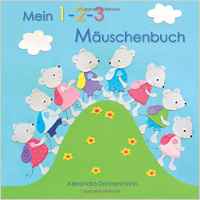
Finally, we will read the book Mein 1-2-3 Mäuschenbuch by Alexandra Dannenmann.

mein-1-2-3-mauschenbuch

This book is available from both Amazon.de and Amazon.com.

I’ll send the children home with a coloring page with 5 little mice.

zahlen-1-5-mause-gita-page-001

Download the PDF here: zahlen-1-5-mause-gita

Save

A Little More for “Martinstag”

I was in the Pre-K/Kindergarten class today. I just love sharing the stories of St. Martin with the children. In a Montessori-based school where the principles of peace and respect are not only taught, but practiced on a daily basis, the kindness and generosity of the St. Martin story fit in beautifully.

This year, I had a new tool for telling the story. I ordered a set of Bildkarten (picture cards) called St. Martin feiern mit Emma und Paul – Bildkarten für unser Erzähltheater. The cards are nice and big (DIN-A3: 11.7 x 16.5 inches), and the images are simple and clear. I didn’t use all of the cards, but chose a few to talk about Martin cutting his cloak in two to share with the beggar, the children crafting lanterns and then parading at night in the town square. There are also some images to show Paul dropping his Martinsmann cookie and Emma breaking her own cookie in two to share with Paul. Very sweet!

The books I have for Martinstag have quite a bit of text. They work fine for story hour, where the children come from German-speaking families. However, I really liked the format of having large pictures to show while I explained the story, simply and in English.

martinstag-bildkarten

After teaching the words to “Laterne, Laterne,” the children made their paper lanterns – with some help from the two teachers and myself. We were glad to have some tape on hand, as a few of the children didn’t quite get the instruction not to cut all the way through! One of the teachers gave the useful tip that cutting the strips in the lanterns is very much like cutting fringe – a work they do regularly in the classroom.

As the children finished their lanterns, they took a seat on the rug until everyone was finished. Then we sang the song as we paraded through the classroom and out into the hall. The principal and several other staff members came out to see where the singing was coming from. She said it sounded like little angels!

If you missed the post on the lantern instructions or the vocabulary cards to help teach the song, click here to go back and take a look!

How do you help the children celebrate Martinstag? I’d love to hear!

Der gute Martin

Next week marks the celebration of St. Martin’s Day. I have to admit, while I lived in Germany, I never actually witnessed the children walking through the streets with their homemade lanterns on November 11th. I didn’t know about the special day until I was teaching in the States at a German Saturday School. It’s such a sweet celebration, though! Now I love to share it with the children at Story Hour and in Preschool.

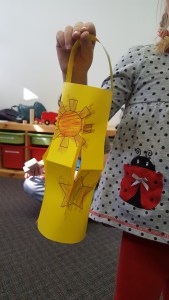
To go along with the celebration, I have created a very simple lantern for the children to make. You can print it out, let them color the paper if they like, and then cut along the dotted lines and assemble it. You can download the template and instructions in PDF format here: martinstag-laterne

2016-11-04-11-10-34

A finished lantern from Story Hour

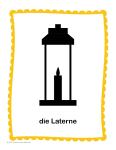
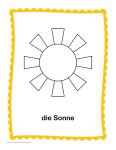
The songs that go with Martinstag are also very important. We always sing two of the most popular ones at Story Hour: “Laterne, Laterne” and “Ich geh’ mit meiner Laterne.” When I teach Preschool, I often just do the first two lines of “Laterne, Laterne,” since it is easy to learn and helps the children learn some of the more important vocabulary words: Laterne, Sonne, Mond, and Sterne. To teach the songs, I made up some vocabulary posters of these four words, a coloring page, and a sheet with the lyrics. You can download all of them in PDF format here:


Here’s an idea of what they look like:

When I teach Martinstag at Story Hour, I include several books. I have a few about Martinstag itself. This year, we’ll be reading Laterne, Laterne, da oben leuchten die Sterne by Dagmar Geisler and Rosemarie Künzler-Behncke (Ravensburger, 2009). I also like to read the fairy tale “Sterntaler” about the little girl who gives away all her earthly possessions to others in need and is rewarded in the end with a shower of coins that fall from the stars to last her the rest of her life. (I actually made my own book of this fairy tale, so I don’t have one to recommend here.) This year, I’m adding a beautiful new book (well, new to me!) called Der rote Faden by Anne-Gaëlle Balpe and illustrated by Eve Tharlet (Minedition, 2014). In this story, little Oli finds a red thread and by passing it on, he learns how little it takes to help others.

Save

Halloween & die kleine Hexe

When I teach German at preschool around Halloween, I like to do a lesson on colors to go with the song, “Ich bin die kleine Hexe”. First we review a few colors. Then we sing the song to practice the colors. At this point in the year, we’re starting with the basics: just the primary colors of red, yellow, and blue.

I created a full-sized poster of a pair of shoes and printed them on red, yellow, and blue paper to use as a cue when we sing the song.

schuhe-kleine-hexe-gita-page-001

There is also a coloring page with three sets of shoes, one for each color. The lyrics are on the sheet as well, so the children can bring them home with them. I often hear from parents about how the children sing the songs I teach them, but they don’t know the songs! So I hope this helps them out.

schuhe-malvorlage-gita-page-001

You can download them each here as PDF:

You can also find the sheet music here at Labbe.

Happy Halloween!

Alles über mich!

For our first session of Lesestunde (Story Hour), I like to do a topic that is all about “ME!” So we read books and sing songs about the body and feelings. For the end of the session, I prepared a few variations of activities, so the children could also report on themselves.

Download the PDF file here: das-lied-uber-mich

Here are the books we read:

  • Heute bin ich by Mies van Hout (2015)
  • Das bin ich by Heinz Janisch & Birgit Antoni (2014)
  • Von Kopf bis Fuß by Eric Carle (2011)

And here are the songs we sang:

  • “Wenn du glücklich bist”
  • “Meine Finger, Meine Finger” (Die 30 Besten Spiel- und Bewegungslieder, Vol. 3)
  • “Kopf und Schulter, Knie und Fuß”
  • “Das Lied über mich” (Volker Rosin)

You can download all the lyrics here: lieder-16-sept-2016 (PDF)

Montags mit Mama: Name Train

Our little Hippo started school last week! He is 3-and-a-half years old and will be going 3 half days (Tuesday, Wednesday, Thursday). I’m so happy – and relieved! – to say that his first week was a huge success! Froggy started 1st grade, and it was an easy transition. This morning, he informed Hippo that he wouldn’t go to school today, and Hippo completely slumped in his chair. Half of me wanted to hug him, since he was so sad, and the other half wanted to jump for joy that he likes school so much! 🙂

My goal is to do a project with Hippo on Monday mornings, since he isn’t in school. It’s a great way to spend some “quality”time together. When Froggy was 3, we used to do projects almost every day – crafts, art, science experiments, all kinds of fun things! And of course, I want to use it as an opportunity for a German lesson!

Today we borrowed an idea from Tippytoe Crafts: Name Trains! Here’s what we needed:

2016-09-12-10-56-05

  • print-out of a locomotive and some tracks
  • colorful squares of paper
  • letter stencils
  • scissors
  • glue stick
  • crayons
  • black paper
  • small circle punch
  • large piece of paper (or a couple of sheets taped together)

I could have had Hippo just draw train tracks, but he hasn’t been into drawing or coloring lately. In fact, his locomotive remains black and white!

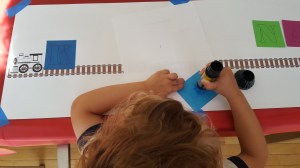
First, we glued the tracks down. Then the locomotive. Next, we started sounding out his name. I think he knows his letters well enough. But I was surprised that he could figure out which ones we needed next. Each letter “car”was glued on to the train. Then he glued on the wheels. He could have colored the letters and decorated the paper, but like I said, he’s just not into it right now.
2016-09-12-11-15-27

After we finished the train, we practiced some color recognition. We even included braun and grau from the tracks!

While we worked, I played some German train songs, too.

  • “Die Eisenbahn, Die Eisenbahn” by Stephen Janetzko
  • “Mit der Eisenbahn” by Ottmar Liedl
  • “Der Schaffner hebt den Stab” by Lamp Leute (Die 30 besten Spiel- und Bewegungslieder, Vol. 2)
  • “Das Tschuu-Tschuu-Eisenbahn-Lied” by Hartmut Höfele
  • “Der Zug ist Weg” by Stephen Janetzko

The clipart for the locomotive was created by Charlotte’s Clips, and the tracks were created by Hidesy’s Clipart.

Zoo Animals

Today, I’m taking my zoo theme to Froggy’s school for their lesson.

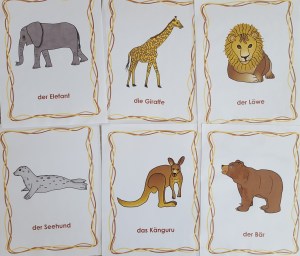
First, I created some word posters to teach the children some of the animal names.

  • der Bär
  • der Elefant
  • die Giraffe
  • das Känguru
  • der Löwe
  • der Seehund

You can download them here: Zootiere Posters (PDF)

2016-05-25 11.45.20

We will then sing “Unser kleiner Bär im Zoo” from Die 30 besten Sing- und Bewegungslieder. In an effort to keep the kids a little calmer and quieter, we’re going to change the words. Our bear is going to nicken (nod his head), winken (wave), and klatschen (clap). I have to admit, it’s also easier to sing when you don’t have to jump and stomp and dance around!

index

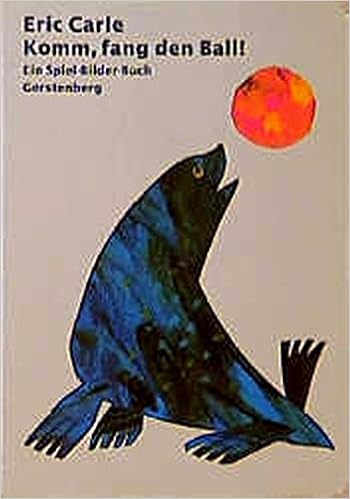
After that, I’ll read another Eric Carle book, called Komm, fang den Ball! (Gerstenberg, 1999) This book has a flat, circular cut-out that acts as the ball. It’s attached to a string that pulls through the whole book, so that each animal can “throw” the ball to another animal.

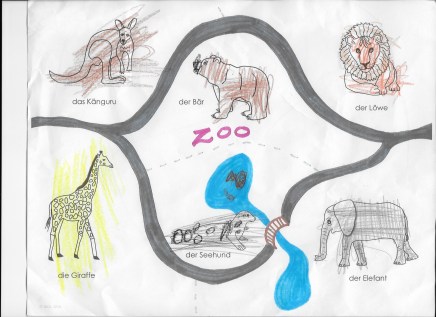
Finally, I updated the zoo map I made for story hour to be a coloring page. You can download that, too: Zoo Karte Malvorlage (PDF) Here’s Froggy’s example (he’s more into fast than neat coloring these days 🙂 )

Zoo Karte AMR GitA

Save