SL: Der dicke, fette Pfannkuchen / The Big Fat Pancake

2019-02-06 14.40.42

Every February, the kids at school get to have a Pajama Day. The student council makes breakfast for lunch. So I was inspired to tell a tale about a pancake!

The children liked the story, because it reminded them of The Gingerbread Man. The nice thing about this story, however, is that in the end the pancake decides to let himself be eaten by three children who have nothing else to eat 🙂

It’s a great beginner text for a Story Listening lesson, because of its repetition.

I told my version with a rabbit, a wolf, a bear, and a pig – in part, because they were animals I knew I could draw! Here is the text I used in German, which you can view and download as a PDF: Der dicke fette Pfannkuchen SL 1,2. And here is an English translation of the text I used (PDF): Big, Fat Pancake English translation

SL: Heidi

2019-02-05 14.41.15

Our au pair from Switzerland came to visit us for two weeks. She was kind enough to come into school to talk to the children about Switzerland and even baked bread with them! So of course I was inspired to tell them the story of Heidi by Johanna Spyri!

The version I told was extremely simple, but most of the children were not familiar with this classic tale! So it was a good introduction. They all enjoyed it!

Here is my abridged version:

Heidi (nach dem Buch von Johanna Spyri)

Es war einmal ein Mädchen. Das Mädchen hieß Heidi. Heidi war sehr lieb. Und sie war allein auf der Welt. Aber sie hatte doch einen Großvater.

Der Großvater wohnte hoch auf einem Berg in der Schweiz. Er wohnte allein in einem kleinen Haus. Er hatte einen kleinen Bauernhof, wo er Ziegen hatte. Großvater war nicht glücklich. Er war oft verärgert und schlecht gelaunt.

Heidi war glücklich, auf dem Berg zu wohnen. Sie liebte die Natur. Und sie liebte die Ziegen.

Da war ein Junge, der sich um die Ziegen kümmerte. Der Junge hieß Peter. Oft ging Heidi mit Peter und den Ziegen hoch auf den Berg.

Heidi war immer sehr lieb. Sie war nie böse zu ihrem Großvater, auch wenn er so schlecht gelaunt war. Nach einer Zeit war Großvater nicht mehr verärgert. Er liebte Heidi.

Eines Tages kam Heidis Tante, Dete. Dete hatte einen Job für Heidi. Aber der Job war weit, weit weg in Frankfurt. Frankfurt war eine Großstadt. In Frankfurt konnte Heidi die Berge nicht mehr sehen. In Frankfurt konnte Heidi nicht in der Natur spielen. Aber Heidi musste nach Frankfurt.

In Frankfurt war Heidi Begleiter für ein Mädchen. Das Mädchen hieß Clara. Clara war krank und brauchte einen Rollstuhl. Heidi und Clara waren gute Freunde. Aber Heidi vermisste Großvater und die Berge. Sie war so traurig, dass sie krank wurde. Heidi musste zurück in die Berge.

Als Heidi zurück in den Bergen war, kam Clara zu Besuch. Eines Tages waren Clara, Heidi, und Peter hoch auf dem Berg mit den Ziegen. Ihr Rollstuhl rollte den Berg hinab! Er war kaputt! Clara musste selber gehen. Und doch! Sie konnte es! Sie war noch schwach und musste üben. Aber sie konnte doch gehen.

Clara ging zurück nach Frankfurt. Und Heidi blieb mit Großvater auf dem Berg. Sie waren immer noch Freunde und besuchten einander. Aber Heidi war glücklich, bei Großvater auf dem Berg zu bleiben.

SL: Was trägt kleiner Bär? / What Will Little Bear Wear?

2019-01-23 14.38.53

2019-01-29 14.35.14

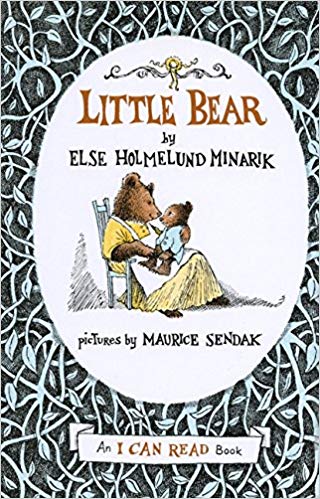
Sometimes a story works so well in 1st & 2nd grade, that I have to tell it again to the 3rd & 4th graders, even if it is a simple one. (The first image is from grades 1 & 2, the second image is from grades 3 & 4.) This story by Else Holmelund Minarik is a sweet classic. Perhaps you know the Little Bear stories, with illustrations by Maurice Sendak?

61E7Ije8NxL._SX318_BO1,204,203,200_

Little bear repeatedly goes inside to tell his mother he is cold. So she gives him a hat, then a coat, then snow pants. Finally she asks him if he wants a fur coat? He says yes! So she takes back the hat, the coat, and the snow pants and there you have it! He has his fur coat and is not cold anymore 🙂

It’s a sweet little story, and has great repetition for a beginner Story Listening lesson.

I added a bit of detail for the 3rd & 4th graders, and they enjoyed it just as much as the younger students.

SL: Dornröschen / Sleeping Beauty

2019-01-22 13.58.28

Sleeping Beauty has always been one of my favorite fairy tales. So when I was looking for a traditional tale to tell, I had to choose this one!

In some ways it was a simple story to tell, since the students were familiar with it. However, the original German from the Grimm Brothers is slightly different from the Disney version that we know. And some of the 3rd & 4th grade students had a harder time wrapping their minds around that idea. They wanted to know why I didn’t call the “evil” fairy Maleficent and draw horns on her. Perhaps I should take a few minutes before the story to talk about the way fairy tales evolve over time and how they can come in many different variations!

SL: Klingelingeling

2019-01-15 14.22.582019-01-16 14.20.45

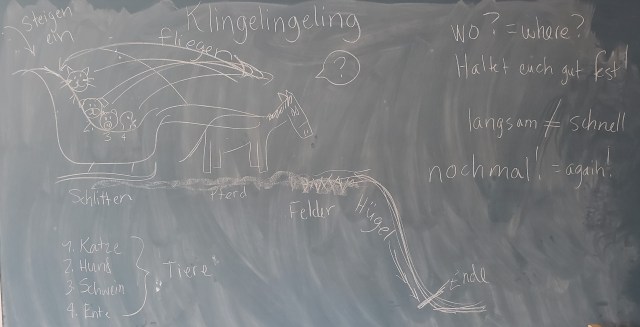
Klingelingeling by Nicola Smee is one of my favorite read-aloud books (arsEdition, 2010; original English title: Jingle-Jingle). It’s a fun story with some great repetition. I told it last year in 1st & 2nd grade. Read about that here.

Even though those students heard the story last year, they didn’t mind hearing it again. Nothing like some repetition for language learning!

You can see my two boards above. The first one (on the white board) was in 3rd & 4th grade. There are a few more details in my story for them. And the chalkboard version was for 1st & 2nd grade.

All the children are surprised when the horse climbs into the sleigh to go down the hill with the other animals! And then of course, when they all go flying out of it at the bottom of the hill, the giggles can’t be suppressed!

It is definitely a hit and a great story for beginning Story Listening in German.

klingelingeling

SL: Der Maulwurf im Winter – The Mole in Winter

2019-01-09 14.39.46

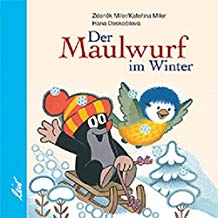
As the weather turns cold and we anticipate snow, I am starting to bring out my winter stories. Here is one about a mole who is eager to go sledding, but there is no snow on the ground. So he and his friend, the chickadee, come up with the idea to give a cloud some water to drink through a straw. Then when the cloud blows some wind, it sends plenty of snowflakes to the ground. The little mole can finally go sledding! Just watch out for that hill!

It was a great story for the 1st and 2nd graders. I was pleased that they were able to guess the my drawing was indeed a mole! And of course, they loved it when the mole went flying off of the hill and landed in the powdery snow.

51iGRDWWnzL._AC_US218_

Der Maulwurf im Winter was written by Hana Dosocilova and Zdenek Miler (LeiV, 2007).

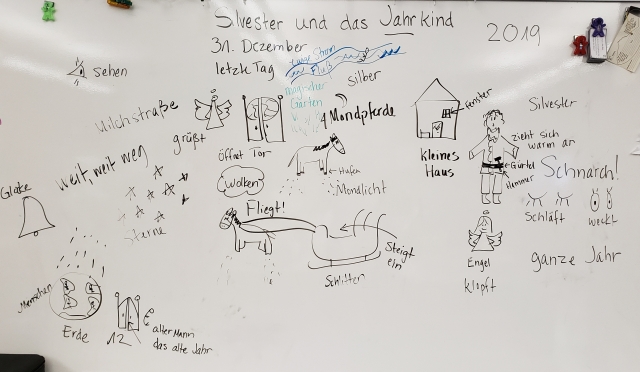
SL: Silvester und das Jahrkind – a fairy tale for the New Year

2019-01-08 14.35.57

A few years ago I stumbled on to an English version of this New Year’s fairy tale by Eduard Mörike.

The story is not included in Mörike’s collected works. He apparently made up the story around 1860 for a little girl named Emilie Schnabel, who was about age 6 or 7. The story made such an impression on the little girl that she later wrote it down when she was an adult. It made its way to Mörike’s family, and that’s how we have it now. The text has been studied by experts, and they agree it matches Mörike’s style.

It is such a beautiful story to tell at the beginning of the new year! I knew that I wanted to tell it as a Story Listening lesson.

It was a little challenging for the 3rd graders, but the 4th graders really got it.

Hobbys

I have been wanting to do a little lesson to get to know my students better, especially the 1st & 2nd graders. So I thought they could make a little booklet about themselves. Today we started with the first page: Hobbies.

But I just couldn’t teach them without telling them a little story. According to the method of Story Listening, you do not teach targeted words or make up your own story. But I broke the rules and wrote a short script that would help to link our lesson on hobbies. Next week, we’ll be back to real Story Listening!

Here is my short story:

Jürgens Hobbys

Es war einmal ein Junge. Er hieß Jürgen. Jürgen war 7 Jahre alt.

Eines Tages hatte Jürgen Langweile. Er fragte seine Mama: „Mama, was kann ich tun?“ – Seine Mama sagte: „Finde ein Hobby!“

Zuerst spielte Jürgen mit der Katze. Aber das wurde langweilig.

Zweitens arbeitete er im Garten. Aber das wurde langweilig.

Drittens spielte er mit einem Ball. Aber das wurde langweilig.

Viertens malte er ein Bild. Aber das wurde langweilig.

Fünftens las er ein Buch. Aber das wurde langweilig.

Endlich spielte er mit seinen Legosteinen. Er baute einen großen Turm aus Legosteinen. Aber der Turm fiel um. Er baute ein Auto aus Legosteinen. Er baute ein Flugzeug aus Legosteinen. Er baute ein Schiff aus Legosteinen. Er baute … und baute … und baute. Aber es wurde nie langweilig!

Endlich hatte Jürgen ein Hobby!

2019-01-03 11.06.29

I forgot to take a picture of my board, but you can see my practice drawings above.

After the quick story, I showed them the booklets. They look like this:

You can download the PDF of the booklet here: Das bin ich GitA. The file includes two versions: one with the writing lines as seen, and one with just two solid lines for older children who do not need the guidance anymore.

So far, the booklet includes:

  • Lieblingshobby (favorite hobby)
  • Lieblingsfeiertag (favorite holiday)
  • Lieblingsbuch (favorite book)

We only worked on the hobbies today. We’ll continue to add to the book, and I hope to add more topics, too. Maybe a page about facts, such as age, a description (hair color, eye color), where they are from, etc.

I also made some vocabulary posters, so the kids could just copy down their favorite hobby. Here is what they look like:

There are also individual posters for soccer, football, and baseball, plus one for riding horses. You can download the PDF file here: Das bin ich Wortschatzposters GitA. The file also includes posters for the holidays.

It seems that Legos are a big hit. No surprise there! Followed by sports, drawing/coloring, animals, and riding horses. The answers were actually rather diverse! Although no one listed working in the garden as a favorite hobby 🙂

Story Listening: Nikolaus und die drei Töchter

Last year I prepared a legend about Nikolaus to teach in 1st & 2nd grade. I used the same story this year to teach in grades 1-4. It still worked great, even though some of the children had heard the story last year. Nothing like repetition!

2018-12-04 14.28.36-2

You can read the legend and download the text from this post.

Last year I had some worksheets for the children, but we did not use them this year. They really are not necessary with Story Listening, and we did not have time.

After the story, the 1st & 2nd graders made lacing boots, like the ones we made in pre-k/kindergarten. Theirs were red with white yard, and they glued white cotton balls to the top to decorate them a bit more. The 3rd & 4th graders colored small pictures of Nikolaus and glued them to little brown take-out boxes. (see this post)

Story Listening: The Nutcracker

2018-11-28 14.50.09

I have been working for weeks on a Story Listening version of The Nutcracker. Not the ballet from 1892, but the original story by the German author E.T.A. Hoffmann from 1816: Nussknacker und Mausekönig (The Nutcracker and the Mouse King).

As I started working with the story, I realized it is extremely complicated! I wasn’t sure if I was going to be able to tell it as a Story Listening lesson. But after becoming increasingly familiar with the story, I finally was able to simplify it enough to tell it in 1st & 2nd grade. I am still working on a slightly more detailed version for the 3rd & 4th graders. I plan to tell it to them in two weeks….

Here is the version of the story that I told in 1st & 2nd grade:

Der Nussknacker – sehr gekürzte Fassung
nach dem Märchen von E.T.A. Hoffmann

Es war einmal ein Mädchen. Das Mädchen hieß Marie. Marie hatte einen Bruder. Der Bruder hieß Fritz. Sie wohnten mit ihren Eltern in Deutschland.

Am Weihnachtsabend kam ihr Onkel zu Besuch. Der Onkel gab Fritz kleine Spielsoldaten. Für Marie hatte er einen Nussknacker aus Holz. Der Nussknacker hatte ein komisches Gesicht. Er hatte große Augen und einen großen Mund mit eckigen Zähnen. Sein Kopf war zu groß. Seine Beine waren dünn. Aber Marie liebte den Nussknacker.

In der Nacht – um Mitternacht – wachte Marie auf. Sie hörte laute Geräusche. Sie hatte Angst. Das Zimmer war voller Mäuse! Die Soldaten von Fritz waren lebendig. Sie kämpften mit ihren Schwerten gegen die Mäuse. Der Nussknacker war auch lebendig. Er kämpfte gegen den Mausekönig. Der Mausekönig hatte sieben Köpfe!

Marie hatte Angst! Aber sie hatte auch Mut, denn sie liebte den Nussknacker. Sie warf ihren Schuh gegen den Mausekönig. Er fiel tot zu Boden. Die anderen Mäuse liefen schnell weg.

Und dann! Der Nussknacker war nicht mehr aus Holz! Er war ein Mann – ein echter Mann! Marie brach den Zauber mit ihrer Liebe und ihrem Mut. Dann war der Nussknacker wieder ein Mann. Und er war ein Prinz! Jahre später heirateten der Prinz und Marie. Und Marie wurde Prinzessin.

Ende.

You can download the story in German here as a Word document: Nussknacker – kurz

And here is the story in English as a Word document: The Nutcracker – English

I have been drawing my story on a piece of paper to practice. I find that it helps me not only to practice drawing each picture, but it helps me figure out where I want it on the board. Then I use the drawing as a reference while I’m teaching the story. I’m not a great artist, but I find that if I have an example in front of me, I am doing pretty well. I’d even say that my drawing abilities have improved in the last 11 weeks 🙂 Here is my paper sketch of the story:

2018-11-28 13.55.05

I have been working with our art teacher again, too! The students in grades 3 & 4 are making clothespin nutcrackers! Read more about that here.