Story Listening: Stille Nacht

2018-11-27 13.53.38

When I learned that I would be teaching German this year, I knew I wanted to tell the story of the Christmas song, “Silent Night.” I first heard the story when I was a little girl. It was one of the songs included in the TV special, John Denver and the Muppets – A Christmas Together. That is still one of my favorite Christmas albums 🙂

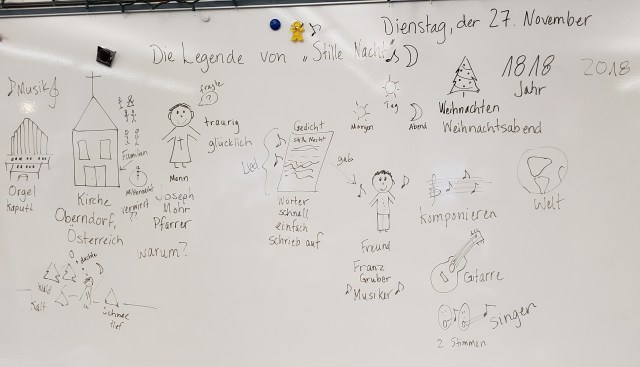
I bought a couple of books about the song. They are pictures books that I could also read to my two boys (see below). But then I did a little research and found that the stories had embellished the truth a bit. But it’s such a beautiful story, that I went ahead and wrote it out as Die Legende von “Stille Nacht”. (Scroll down to read & download the story in German.)

According to the Stille Nacht Gesellschaft (Silent Night Society), the lyrics were written in 1816 by Joseph Mohr in Mariapfarr in the Lungau region of Austria. Two years later Mohr was an assistant priest in Oberndorf. Some say that the organ of the church was broken, so that they needed music for their Christmas Eve service. Whatever the reason, Mohr gave his poem to the church organist, Franz Gruber. For the Christmas Eve service in 1818, Mohr and Gruber led the choir in singing the song, while Mohr accompanied the singing on the guitar.

I called it “Part I” because I would like to add a part about how the song was spread by two singing families (the Strassers and the Rainiers) through Austria to the world. Maybe next year?

And did you know that it is the 200th anniversary of the song?! It was first performed in Oberndorf, Austria in 1818!

Here is the text of the story that I told:

Die Legende von “Stille Nacht”, Teil I

Es war kurz vor Weihnachten im Jahr 1818. Ein Mann saß in der Nicholaskirche in Oberndorf, Österreich. Der Mann hieß Joseph Mohr. Er war Pfarrer in der Nicholaskirche. Pfarrer Mohr war traurig. Die Orgel in der Kirche war kaputt. Am Weihnachtsabend würden sie keine Musik haben. Weihnachtsabend ohne Musik? Unmöglich!

Pfarrer Mohr ging in der Nacht im Wald spazieren. Es war kalt. Der Schnee war tief. Alles war still – ganz still. Der Mond schien durch die Bäume.

Als Pfarrer Mohr ging, dachte er sich ein Gedicht aus. Die Wörter kamen einfach und schnell in der stillen Nacht. Er ging nach Hause und schrieb das Gedicht auf.

Am nächsten Tag ging Pfarrer Mohr zu einem Freund, Franz Gruber. Herr Gruber war Musiker. Er spielte die Orgel in der Kirche. Pfarrer Mohr gab Herrn Gruber sein Gedicht. Er fragte: „Können Sie Musik für das Gedicht komponieren?“ Pfarrer Mohr wollte Musik für Gitarre und zwei Stimmen. Herr Gruber sagte: „Ja!“ und komponierte die Musik.

Am Weihnachtsabend kamen Familien um Mitternacht in die Kirche. Alle waren verwirrt. Wo war die Musik? Warum spielte Herr Gruber die Orgel nicht?

Plötzlich hörten sie eine Gitarre. Es war Pfarrer Mohr! Dann begannen er und Herr Gruber zu singen! „Stille Nacht, heilige Nacht.“ Das Lied war wunderschön. Alle waren glücklich. Herr Gruber war glücklich. Pfarrer Mohr war glücklich. Sie hatten Musik am Weihnachtsabend!

Heute hört man das Lied in der ganzen Welt!

You can download the text in German here: Die Legende von Stille Nacht – Deutsch (Word)

And here is a translation into English here: The Legend of Silent Night – English (Word)

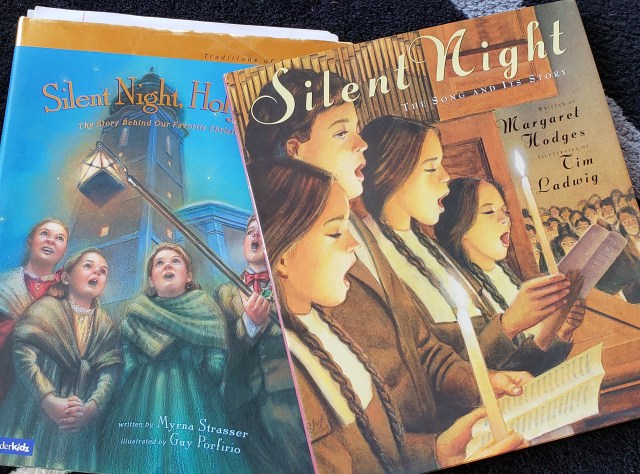
These are two of the books I also used as inspiration:
2018-11-29 13.38.45-2

  • Silent Night, Holy Night by Myrna Strasser (Zonderkidz, 2004)
  • Silent Night. The Song and Its Story by Margaret Hodges (Eerdmans, 1997)

The second book also recounts significant stories about the song, such as when it was sung during World War I by German and British soldiers during a Christmas Eve truce. There is a lot that could be done with this song!

I did some research online to find more of the historical facts:

I told the legend in grades 3 & 4. After I finished, the children were eager to sing the song, too. I prepared the German lyrics on three pages, so that they could see them well.

You can download the PDF file of the song here: Stille Nacht Lied beibringen – GitA

Story Listening: Die rote Blume

2018-11-20 13.51.13

Die rote Blume” is a short story – a VERY short story – from a collection by Erwin Moser. It is from his second collection about two mice named Manuel und Didi. These two mice are best friends and have all kinds of adventures. (Manuel & Didi: Das zweite groĂźe Buch der kleinen Mäuseabenteuer, 2009)

I’ve always loved reading these stories in my German story hour at the library. They are entertaining for both the children and the adults 🙂  They can be a little tricky to use for Story Listening, because there is often a humorous or ironic twist at the end. That can be hard to capture in a way that the children understand. This one is a bit more straightforward.

The children enjoyed the story, so I’m sure I’ll be telling them more about Manuel & Didi later in the year.

Manuel und Didi II

Story Listening: Sterntaler

2018-11-13 13.51.41-2

After talking about Martin’s Day, I always like to tell the story of Sterntaler – or Star Money. It is a fairy tale from the collections of the Brothers Grimm.

The story is sweet and goes along nicely with the theme of generosity and giving to those less fortunate. After the girl, who is alone in the world, gives away all her possessions, she is rewarded as the stars fall from the sky and become coins and she suddenly has a beautiful “Unterhemd” – a kind of slip – made of beautiful silk.

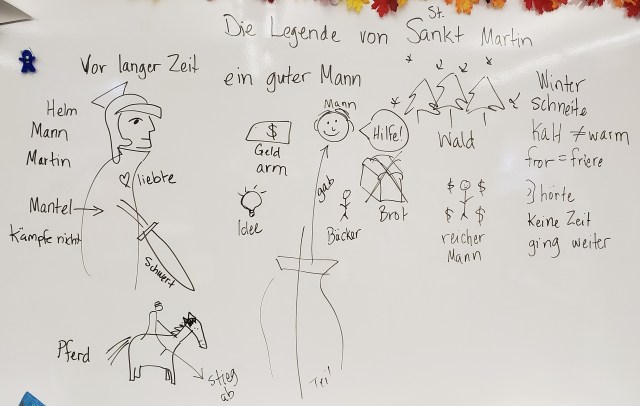
Story Listening: The Legend of St. Martin

2018-11-06 14.34.03

On November 11th, children in Germany, Austria, and Switzerland will be celebrating Martinstag. We are planning our own little celebration at school with all the children from pre-k through 4th grade.

So of course, I had to tell a story about St. Martin. Legend has it that Martin helped a beggar who was freezing by cutting his cloak in two with his sword.

I told another part of the story in English. Martin had become a monk and was living in Tours. When a new bishop was needed, the people turned to “the good Martin”. But he was so humble that he did not want to be bishop. He ran away and hid in a goose stall. The people of the town went searching for him. They lit their lanterns to guide them through the night. But it was the squawking geese that finally gave him away! And he did then agree to become the new bishop.

I took out a few of the details to simplify the story in 1st and 2nd grade. They still got the idea!

2018-11-07 14.45.14-2

This story is available on the Great Story Reading Project 🙂

Story Listening: Halloween Story

2018-10-30 14.41.29

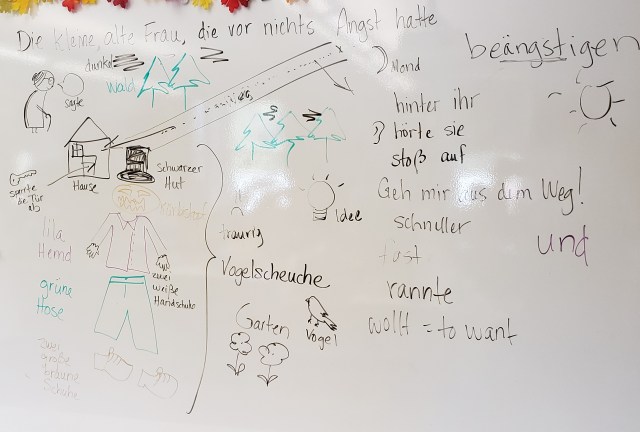
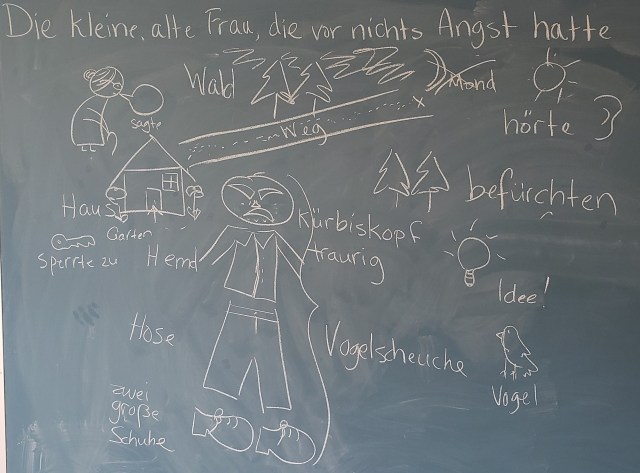
I’m not a fan of scary stories. And the last thing I want to do is frighten a child, even at Halloween! But I still wanted to tell a good story with a Halloween theme. So I found the book The Little Old Lady Who Was Not Afraid of Anything by Linda Williams.

The little old lady is followed home by two shoes, a pair of pants, a shirt, gloves, a hat, and a scary jack-o-lantern. But when they don’t frighten her, they get sad. But she has an idea! The next day, she wakes up to see them all standing in her garden making the perfect scarecrow!

This story is perfect for Story Listening, because of the way it repeats. The ending was a little tricky to make clear, though. I’ll have to work on that for next time.

In 3rd & 4th grade, I’m teaching in a different room, so I now have a white board instead of a chalk board. The pictures don’t come out quite as well 🙂

I tried something new with this lesson. I gave the children a sheet of paper with some of the words on it, so they could draw along with me. My intention was for them to be more attentive in their listening. But I don’t think it worked very well. They were too concerned with their drawings. I saw more of the tops of their heads than their eyes! It was a good experiment. Maybe I’ll try having them draw after the story another time.

1st & 2nd Grade

I simplified the story even more for the younger children. I took out the gloves and hat and also removed some of the descriptive colors of the clothes. It made the story go a little faster, since I don’t have as much time to spend with them.

2018-11-01 13.34.37

Story Listening: Das grĂĽne Halsband

2018-10-17 14.48.29

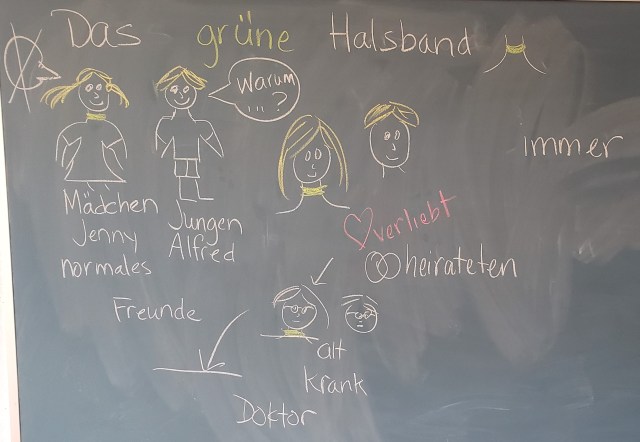
Because my lesson on How the Apple got its Star was a little too challenging – and long – for my 3rd & 4th-graders, I knew I had to choose something simpler for the 1st & 2nd-graders this week. So I went with a Halloween-themed story: Das grĂĽne Halsband (or The Green Ribbon).

I knew the story from the I Can Read series: a book called In a Dark, Dark Room and Other Scary Stories. It’s not really scary. More like a little creepy – and just plain weird. Here’s the thing, though. I personally don’t really like the story. And when I don’t like the story, the lesson just does not go as well. I wanted to like it. I tried to make it work. But it really did not go over very well. Lesson learned!

This story is available on the Great Story Reading Project 🙂

Story Listening: Wie die Sterne in den Apfel kamen

2018-10-16 14.38.30

This lovely story about how the apple got its star come from the Waldorf schools. You can read the original English here.

The story tells about a little seed that is sleeping in the earth until one morning it is awakened by Mother (or Father) Sun. After it pokes its head up out of the soil, it is enchanted by all the sights of nature that surround him. That night, he sees the dark sky full of stars and wishes to have one for himself. A fairy visits him and tells him that he will have his wish granted if he works hard to grow strong and fill himself with love. Eventually the seed becomes a tree with little buds, and the tree becomes a father/mother to the little pink buds. He takes such loving care of them and is so happy, that he forgets all about his wish to have a star. When the fairy returns, the tree is full of red apples, and he tells the fairy that he no longer needs a star of his own. So she declares that she will hide a star inside each apple for the little children to find.

After we read the story, I cut open an apple for the children to see the star. I think that was the best part 🙂  I’m not sure how many of the children had ever seen the star inside of the apple. The trick is to cut it through the “equator” – not from stem to bottom. Makes it trickier to cut up for eating, but it does reveal the magic!

As it turns out, this story was rather challenging. It was a little long and a little too hard for my beginners to understand. I think in the future, I will either save this for a second-year lesson or simplify it some more.

Because it was challenging for my 3rd & 4th-graders, I decided not to tell this story to my 1st & 2nd-graders. I told them the somewhat creepy Halloween-time story of the green ribbon instead….

This story is available on the Great Story Reading Project 🙂

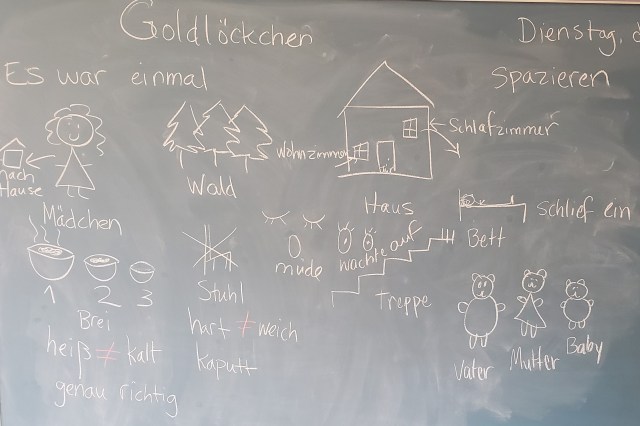
Story Listening: Goldlöckchen

2018-10-09 14.35.56

This week’s story was Goldilocks. Even though it is a story that is familiar to the children, it still works great for Story Listening. There is something comfortable about knowing the story and being able to predict what is coming next.

1st & 2nd Grade:

We sang a new song in class: the German version of “Head, Shoulder, Knees, and Toes.” In German, you sing “foot” instead of “toes.” It goes like this:

Kopf, Schulter, Knie und FuĂź, Knie und FuĂź
Augen, Ohren, Nase und Mund
Kopf, Schulter, Knie und FuĂź, Knie und FuĂź

(That funny letter in “FuĂź” is called an Eszett and is basically a double “s.”)

Sometimes it is hard to sing a song that you already know in another language! So we’ll keep working on it 🙂

3rd & 4th Grade:

We have been working on colors the past two weeks. So we added some new ones: schwarz, weiß, braun, grau, & rosa (black, white, brown, gray, & pink).

Although I shouldn’t really say “working,” because mostly we are having fun with these words! The children love to play games, so we played a round of “Ich habe …, Wer hat…?” (I have, Who has?). (I got the game here.)

And we played their favorite game: Ja oder Nein. I hold up a color and ask if they like it (in German, of course). If the answer is yes, they say, “Ja!” and move to one side of the room. If the answer is no, they say, “No!” and move to the other side of the room. We have had to add in der Mitte (in the middle) for those who can’t quite make up their minds 🙂

Goldilocks is available on The Great Story Reading Project 🙂

Story Listening: Das Langnasenschwein

2018-10-02 14.39.07

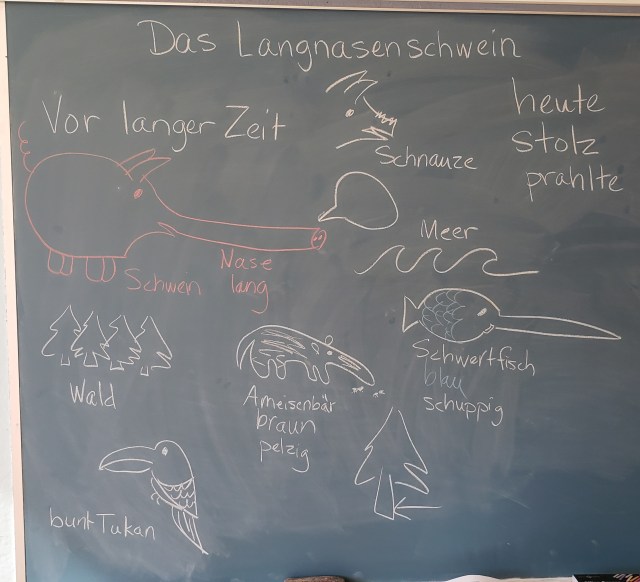
This week’s story was based on a book called The Long-Nosed Pig by Keith Faulkner. It is a story in the tradition of Kipling’s Just So Stories and tells how the pig got it’s short, wrinkled snout. I actually found the book over the summer when we stayed at an air B&B in the Netherlands. It was in the home-owner’s collection of children’s books, and I thought it would be fun to use for Story Listening.

The book is out of print, but if you Google it, you will find a few YouTube videos of it being read in English.

The story tells of a pig with a very long nose. He is so proud of his nose that he goes around boasting about it to other animals. He trots away, holding his nose up proudly. Until finally, he holds his nose up so high that he can’t see where he’s going and runs smack into a tree! And that is how the long-nosed pig got it’s short, wrinkled snout.

Well, it turns out the the children were not all familiar with Just So Stories. So that interfered a bit with their comprehension of the story. Also, for some reason, I wasn’t sure if they would know what a toucan is, so I changed it to a parrot. Obviously, the parrot does not have a particularly long nose, but it is a rather distinctive one!

1st & 2nd Grade:

I decided to give the toucan a try, and of course they knew what it was! Here is what the board looked like with that drawing:

2018-10-03 14.47.53-2

Story Listening: Eine Reise

2018-09-25 14.31.58

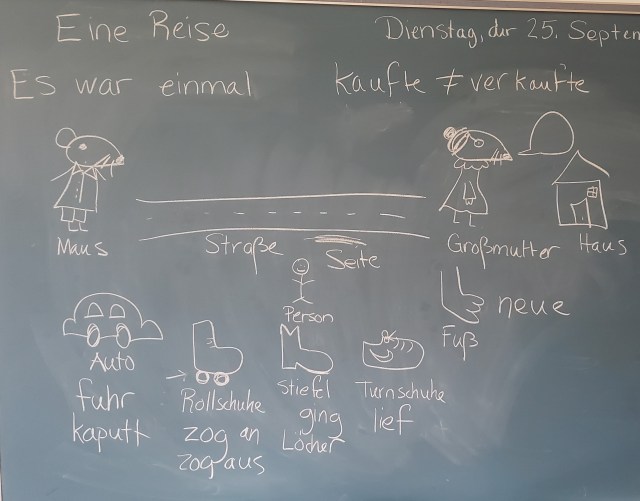
This week’s story was taken from an easy ready called Mouse Tales by Arnold Lobel. You may also know him from his Frog and Toad stories. I really enjoy his humor 🙂 Alas, humor does not always translate well, and the kids didn’t quite get the punchline. But it was still a good story.

The story is called “A Journey.” It is about a mouse who wants to visit his mother (I changed it to grandmother). Along the way, he encounters all kinds of challenges, but there is always someone on the side of the road selling something – roller skates, boots, sneakers – to help him on his way. When at last he can’t go one more step, there is a person at the side of the road selling … feet! He buys them and puts them on and makes it all the way to dear grandmother’s house!

So telling a joke in a foreign language can be tricky! Even after I explained it in English, the kids didn’t seem to quite understand. Because, really, you can’t just take off your feet and put on new ones!

Nevertheless, the story had some rich vocabulary, and we had fun with it.

I’m using the same story in grades 1 – 4, since they are all beginners. Somehow, each lessons is always a little different….

Grades 1 & 2:

I started the lessons with a little TPR to get the “wiggles” out. It’s kind of like Simon Says. This week, we did a series about washing hands and then sang the song “Hände waschen”. (You can listen to the song in this YouTube clip.)

I also used a counting rhyme – like eeny meeny miney mo – to invite the children to the rug for our story. It just happens to correspond with the story, because it talks about taking off and putting on shoes!

Eine kleine Mickymaus
zog sich mal die Schuhe aus,
zog sie wieder an,
und du bist dran!

Grade 3:

We had a little scheduling confusion, so the lesson was shorter today. We only got to sing our hello song and hear the story. But that is the most important part of the lesson anyway! We’ll play games again next week 🙂

Grade 4:

Because of the scheduling confusion, the 4s actually had a longer lesson. Since they had decided to pick new German names, I handed out name tags for each of them, and we did a little Q&A about who was who.

We also played a game based on the food from the Hungry Caterpillar lesson. It was a simple game of “I have, who has”. I made up the cards to have everything they needed to say in German. We played two rounds of it, and they improved so quickly! Here is a sample of the cards:

You can download the PDF of the card game here: kleine Raupe Ich habe Wer hat – GitA

They wanted to play our yes or no game again, so we played that, too. I just held up a card an asked who like each food. If they liked it, they said “ja” and went to one side of the room. If they didn’t like it, they said “nein” and went to the other side of the room.