Martinstag in the Classroom: Part 2

As I mentioned in a recent post, I love teaching about Martinstag, because it embodies the spirit of giving and selflessness. In the past, I’ve taught about Martin in the German story hour and in the pre-k/kindergarten class. This year I finally got to bring it into the 1st and 2nd grade class. Each class is a little bit different. In this post I’ll tell you about what we do …

in 1st & 2nd Grade…

This is a mixed class of 22 students. I couldn’t just jump right in with books and songs, like I did in Story Hour. Instead, I started with the story of Sterntaler. The children were outraged that the poor girl was all alone! And then shocked when she kept giving everything away! They were right with me the whole time 🙂  My board looked a little different, since they needed more help to understand it. But they had also experienced the method the week before when I told them Goldilocks. Here is a picture of my finished board for Sterntaler:

2017-11-03 15.06.15

After that, I read them the story of Martin, using the book Das erste Buch von Sankt Martin by Erwin Grosche (Gabriel Verlag, 2017). I used the book mainly for the illustrations and wrote out the story in English beforehand. I knew after hearing Sterntaler, that was probably enough German for that class (especially since it was 2pm on a Friday … the week of Halloween!).
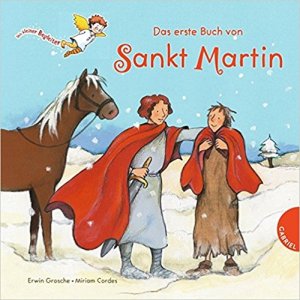
Martin

Next I wanted to teach them the song, “Laterne, Laterne“. The beginning is so simple with its four words: Laterne, Sonne, Mond, Sterne. I knew they would need a little movement by this time, though, so I came up with a little game. I had printed out the vocab words on small cards. I printed enough so that each child could have a card. I just used my full-sized word posters and printed them 4-to-a-page. Then I laminated them and cut them down to size.

I handed the cards out to the children and then had them get into groups according to the picture – in order, of course! I had already gone over the words using my full-sized word posters. So they were familiar enough with the vocab. I called out a word, and that group had to raise their picture and say the word. I mixed them up and first. Then I told them to pay attention, because we were going to speed it up! And I went in order according to the song: Laterne! Laterne! Sonne! Mond! Sterne! They enjoyed the little game. And weren’t they surprised when I told them they had just learned the beginning of a song?!

You can download the word posters along with song lyrics in the post Der gute Martin.

Finally, it was time to make our lanterns! We did them a little differently in this older class. Although in hindsight, I’m not sure I would do it this way again!

  1. I gave them white paper cut down to size (without the strip for the handle) and let them color it however they liked.
  2. I gave them the lantern template printed on yellow paper (without the sun, moon, and stars – just the lines for cutting and folding) and asked them to cut the strip off the end to make the handle.
  3. They glued their white paper to the yellow template (I might do this step myself, in advance, if I try it again).
  4. They folded the paper (I was surprised how many of them did not fold on the line, but folded the long edge of the paper up to the line! If you read my post with instructions, you’ll see why I decided to give step-by-step instructions the next time!)
  5. They cut the “fringe”.
  6. We went around and stapled the lanterns together along with their handles

The lanterns turned out alright in the end. But it took so long that we did not have time to parade in the halls.

Then again, it was the last hour of school on a Friday. And did I mention it was Halloween week?? Scary stuff!! 🙂

Tutorial and templates can be found in the post Martinstag Lanterns!

Viel Spaß!

Bewegungen – Action Words

For three weeks, I’ve been doing numbers in the Pre-K/Kindergarten class. I was wondering if the repetition was good, or if the children needed a little variation! So I came up with a compromise for today’s lesson. We still included number, but we also added some new vocabulary.

We have been starting each class with our Hallo-Lied and working on ich heiße.

As a quick review, we sang “Meine Finger” again. Just like on the first day, we used klatschen and patschen. I added schnipsen this time, too. And to review numbers, we counted to 5 as we did the actions five times each.

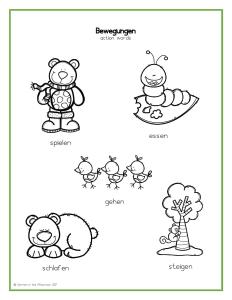
Then I introduced some verbs. We already talked about schlafen with the song “Unser kleiner Bär im Zoo,” but we repeated that one again here. Then we also added gehen, essen, spielen, and steigen (to walk, to eat, to play, to climb).

In addition to the word posters, I created a coloring sheet for the children to take home:

Bewegungen AB GitA-page-002

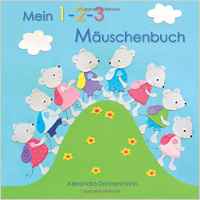
I chose these words because of the book we read: Mein 1-2-3 Mäuschenbuch by Alexandra Dannenmann. In addition to counting from 1 to 10, each page shows a different action. I decided to select just five of the action words to introduce.

mein-1-2-3-mauschenbuch

Usually, I read the book last. But I wanted to end this class with a fingerplay that the children always love! It’s called Die Mausfamilie. You can read the text and download it on this post from last year.

The action word posters and coloring page are free to download here:

Viel Spaß!

Hallo und guten Tag!

For years, I have been singing the same song with the Lesestunde and in the Pre-K / Kindergarten class I teach. I’ve been wanting to post about it, but I had to track down the source first!

It turns out that the woman who ran the Lesestunde while I was taking a maternity break found the song in a French book and translated it into German. No wonder I could never find it with an internet search! She was kind enough to send me images of the book and the song:

The song goes like this:

Hallo! * *  Und guten Tag! * *
Hallo! * * Und guten Tag! * *
Ich hoffe, es geht dir
Ich hoffe, es geht
Es geht dir gut! * *
* klatschen, stampfen, patschen (clap, stamp, pat) – zweimal

In the Lesestunde, I always start out by asking what the children would like to do: stampfen? klatschen? hüpfen? One little girl always likes to spin. Makes me dizzy, though!

When I sing it in the Montessori class, we always do the same actions in the same order: klatschen, stampfen, patschen. Right off the bat, we start learning numbers, because I’m always saying, “eins, zwei!” to make sure they don’t get too carried away. Especially with the stampfen. They love to stomp. And then it turns into jumping. We’re still working on that with the little ones 🙂

On the first day of German in the Montessori class, I start the lesson by teaching them the three actions. I made up word posters to help them learn the words:

I also send them home with a coloring page that has the words and the actions. There are two versions, but I like the one that uses the same images above.

You can download the PDF documents here:

Word posters: Begrüßungslied Wortschatzbilder GitA

Coloring pages: Begrüßungslied Malvorlage GitA

Viel Spaß!

Unser kleiner Bär im Zoo

I love using songs to teach and learn language.

I also find it rather difficult to teach songs German songs to my English-speaking students. Sometimes, they are actually quite complicated!

So this year in my Pre-K/Kindergarten class, I’m trying to repeat the songs more often. A lot more often. That is a hard thing for me to do! I love a good theme and have usually planned my lessons around a theme: colors, farm animals, numbers, holidays, etc. But by planning my lessons this way, I trap myself into a place where I am constantly introducing new vocabulary, new books, and new songs!

Even at this level, it’s really important to me that the children are getting something out of the class. At the very least, that they learn words that they will understand. Even better is when I hear them saying the words … phrases … sentences! But that will not happen without some repetition.

One of the songs I love to sing is “Unser kleiner Bär im Zoo” by Karsten Glück (from Die 30 Besten Spiel und Bewegungslieder, Vol. 1). I like to use it in week 2, so that we can review the actions in our hello song: klatschen, patschen, und stampfen. I always do “stampfen” last, so that we can stay low to the ground until the end. It helps to keep the little ones more in control of their bodies, too!

So this week (week 3), we’re going to sing it again, but in conjunction with a zoo theme. (More on that soon!)

I put together a visual to introduce the song. It includes an image of a zoo, plus a small (klein) and big (groß) bear. The little bear is sleeping, while the big bear (the Mama bear, I call her) is awake.

Unser kleiner Bär im Zoo mit Bildern-page-004

In this second lesson with the song, I plan to use the image again to add some vocabulary. Something like this, that focuses on the conjugated verb “schlafen” and also adds a yes/no question.

  • Unser kleiner Bär schläft.
  • Mama Bär schläft nicht.
  • Schläft er? Schläft sie?
  • Wer schläft? – Er schläft. Sie schläft nicht.

We’ll see how it goes!

You can download the PDF of the image plus the lyrics here: Unser kleiner Bär im Zoo mit Bildern – GitA

Viel Spaß!

Back to School = Buchstaben!

It’s time for the kiddos to go back to school. At this time of year, I always get inspired to bring more German into their day! So I’m gearing up to begin our letter work. I did a lot of this work with Froggy three years ago. And now it’s Hippo’s turn. I’ll include Froggy as much as possible, but on a higher level, of course. So I am busy printing, laminating, and cutting! Because even though I’ve done a lot of this before, there is always room for improvement!

I’d love to share all these materials with you here. But I have also promised myself to focus more on teaching (and planning & prepping) for my kids and a little less on the blog. So forgive me if the posts are short & sweet!

We start tomorrow with the letter B. Why? Because I want to teach them in groups according to how you say them. The letter B is one of the easiest sounds to say. So that is where we’ll begin.

I’ve been collecting mini objects beginning with each letter of the alphabet. And I’ve created vocabulary cards to go along with each object/word. The words for the letter B are:

  • der Bagger
  • der Ball
  • die Banane
  • der Bär
  • der Baum
  • der Bauer
  • die Birne
  • der Bolzen
  • das Buch
  • der Bus

Because there is room on the cards for 12 images, I also added das Baby and das Boot. But I don’t think we’ll get to those. I thought we would introduce two words per day (for 5 school days in a week). We’ll see, though….

The cards are about 3×3 inches. There are three sets:

  • words only
  • pictures only
  • pictures with words

There are plenty of ways to use the cards! I’ll write more about that later…. (Dinner is almost ready!)

In the meantime, you can download the cards here: Wortschatz Karten B

Viel Spaß! I’d love to know how you use the materials! Please comment below!

Vehicles

I can’t believe the school year is almost over! And I can’t believe I haven’t done a vehicles topic for the children yet! So I grabbed one of my favorite books for inspiration: Kikaninchen’s Wer fährt heute mit (arsEdition, 2011). It doesn’t necessarily have the most common of vehicles (a submarine and a soap box car?!), but it’s a cute little story. It also includes days of the week and animals.

I began the lesson by introducing the vocabulary to the children. I couldn’t find a picture of a soap box car, so we skipped that one for now! And since I planned on singing “Die Räder vom Bus” we had to include a bus. I like to keep the new words to only 5 or 6. But I created word posters for 9 vehicles:

  • das Auto
  • der Bus
  • der Heißluftballon
  • die Rakete
  • das Schiff
  • der Traktor
  • das U-Boot
  • der Zug


You can download the PDF file here: Fahrzeuge Posters GitA

Then we sang “Die Räder vom Bus” (Wheels on the Bus). There is more than one version of this song. But here is one that I have:

Die Räder vom Bus

Die Räder vom Bus, die rollen dahin
rollen dahin
rollen dahin
Die Räder vom Bus, die rollen dahin
Stundenlang
Die Türen vom Bus gehen auf und zu...
Die Wischer vom Bus machen wisch wisch wisch...
Die Hupe vom Bus macht tut tut tut...
Die Leute im Bus schaukeln hin und her...

Finally, we read our book:kika-wer-fahrt-heute-mit

And of course, I sent the children home with a coloring page.

Fahrzeuge Malvorlage GitA-page-001

Download it here: Fahrzeuge Malvorlage GitA

A Trip to the Philadelphia Zoo

Last summer, we finally took the boys to the Philadelphia Zoo. Of course, I had to work in a German lesson!

So I made up word posters for 16 of the animals that can be found there. Hopefully your local zoo has similar animals! There are three sets of cards:

  • pictures with words
  • just pictures
  • just words.

You can print them in full 8½ x11 or print more to a page for smaller versions. I like to print 6-to-a-page, laminate them, and cut them down to 3×4 cards. Then we use them to play memory, go fish, or other games! If you’ll be using them for memory, be sure to print on thick card stock or paper with a patterned back! The animals included are:

  • der Bär – bear
  • der Eisbär – polar bear
  • das Erdmännchen – meerkat
  • die Gazelle – gazelle
  • die Giraffe – giraffe
  • der Gorilla – gorilla
  • das Känguru – kangaroo
  • der Lemur – lemur
  • der Leopard – leopard
  • der Löwe – lion
  • das Nashorn – rhinoceros
  • das Nilpferd – hippopotamus
  • der Orang-Utan – orangutan
  • der Penguin – penguin
  • der Tiger – tiger
  • das Zebra – zebra

Here’s a sample of what they look like:

Download all the posters as a PDF here: Zootiere Posters Phila Zoo GitA

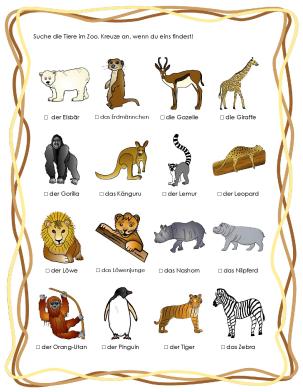
On the day of our outing to the zoo, I gave the boys a scavenger hunt. It looks like this:

Auf der Suche im Zoo GitA-page-002

Included in this PDF document is a worksheet to keep track of the animal name, the color of the animal, and its climate. Download it here: Auf der Suche im Zoo GitA

Viel Spaß im Zoo!

Happy Mother’s Day!

We celebrated Mother’s Day in the pre-K class this week. We read a book called Bist du meine Mama? about a little chick that goes looking for its mother. It was perfect, because they were actually hatching chicks at school!

The book takes place on a farm, so first we reviewed our farm animals and what they say. The children love to hear the different animal sounds, especially ones that are very different, like the frog that says “quak” like our English ducks!

  • das Küken sagt “piep-piep”
  • die Katze sagt “miau”
  • der Hund sagt “wau-wau”
  • das Schwein sagt “oink-oink”
  • die Kuh sagt “muh”
  • der Frosch sagt “quak-quak”
  • die Henne sagt “gack-gack”
  • der Hahn sagt “kikeriki”

I have several sets of farm animal word posters. Sorry there isn’t one easy document for this story! And even though there isn’t a horse or a duck in this book, I’m including those, too.  You can download them here:

They look like this:

Songs about animals or the farm have been hard to come by. And I couldn’t really think of a song about a mother that would work. These songs in the pre-K class have to be very, very simple! So in the end, I thought of doing a lullaby 🙂 We sang “Schlaf, Kindlein, schlaf” and I had the children do simple motions with it:

  • Schlaf, Kindlein, schlaf  –  pretend to sleep
  • Dein Vater hütet die Schaf  –  use arms to “gather” the sheep & then pretend to hold a sheep
  • Die Mutter schüttelt das Bäumelein  –  hold arm up like a tree trunk with the hand as the branches and wave the arm & hand, as if the tree is shaking
  • Da fällt herab ein Träumelein  –  hands slowly “rain” down a soft dream (think “Itsy-Bitsy Spider rain!)
  • Schlaf, Kindlein, schlaf  –  pretend to sleep again

They really enjoyed it. And – bonus! – it also settled them down a bit 🙂

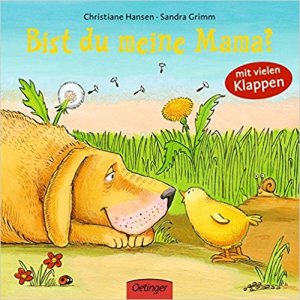
We ended with our book, Bist du meine Mama? by Christiane Hansen (Oetinger, 2006):

Bist du meine Mama

Then I sent them home with a coloring page: Alles Liebe zum Muttertag (PDF)

Alles Liebe zum Muttertag-page-001


Happy Birthday!

Finally I’m getting to cover a topic in our preschool class that I’ve been wanting to do for some time…  BIRTHDAYS!!

One of the boys in the class had a birthday over the weekend, and he is having his birthday celebration in class in the morning. We’ll have to move our class back a little bit to accommodate the celebration. But it’s such a special event in the school, I don’t mind a bit!

I’m not sure how it is in other Montessori schools, but in our school, birthdays are a big deal in preschool and kindergarten. The whole family is invited to come for a short celebration. First, the children set up a sun with the months around it in the center of the circle. Then the birthday child is brought to the circle by two friends. The parents bring in some pictures of the child – about one from each year – and tells a short story of the child’s life. For each year, the child walks around the sun while holding a small globe of the earth, and everyone sings: “The earth goes around the sun, tra la, the earth goes around the sun! The earth goes around the sun, tra la, another year is done!” The child also presents a small present to the class (a book or some other materials that can be added to the collection of classroom “work”). And then everyone sings Happy Birthday, but with an added verse: “We celebrate your birth – and your place on earth. May the sun, moon, and stars – bring you peace where you are!” It’s so beautiful, I cry every time!

So I was inspired to do a little lesson on German birthdays. After our Begrüßungslied, I thought I’d teach the children how to say how old they are: Ich bin x Jahre alt! They are pretty good at their numbers by now, so it shouldn’t be too difficult.

Then I’ll introduce a few vocabulary words that are important to any birthday celebration:

der Kuchen  ~  das Geschenk  ~  der Papphut  ~  die Luftballons

You can download these word posters here: Herzlichen Glückwunsch Word Posters GitA 2017

I’ll also teach them how to sing “Happy Birthday” in German. We’ll leave out the name to keep it simple:

Zum Geburtstag viel Glück!

Zum Geburtstag viel Glück!

Zum Geburtstag viel Glück!

Zum Geburtstag viel Glück!

I was going to read a book called Der Bär hat Geburtstag by Isabel Pin (Beltz & Gelberg, 2015). It’s about a bear who is worried that none of his other animal friends will come to celebrate his birthday … but of course they all do! I liked the different animals in it, and it also showed the birthday images above (cake, hat, balloons, present).

But in the end, I decided to go with Die Maus, die hat Geburtstag heut by Paul Maar (Oetinger, 1997). It is about all the different animals and they presents they bring to the mouse on his birthday. What I liked about this one for the preschoolers is that it repeats the same text for every animal:

“Die Maus, die hat Geburtstag heut. Gleich kommt Besuch, der sie sehr freut. Welches Tier kommt denn hier und will der Maus was schenken?  …

Nun schau gut hin, nun gib gut Acht: Was hat das Schwein denn mitgebracht?”

You get a hint of the animal who is coming (like the trunk of an Elephant), then turn the page and have a sentence about that animal. Then comes the question of what the animal brought as a present. It doesn’t show all the birthday vocabulary I wanted to introduce, but I think that’s okay. The repetition is more important in this case!

Because we’ll be reading about a mouse, I also will do the Mausfamilie Fingerspiel again. They always love that one!

die-mausfamilie-fingerspiel-w-translation-page-001

Here is the PDF of Die Mausfamilie that you can download: die Mausfamilie Fingerspiel with translation

I always send them home with a coloring page, too!

Herzlichen Glückwunsch zum Geburtstag Malvorlage GitA 2017-page-001

You can download that here: Herzlichen Glückwunsch zum Geburtstag Malvorlage GitA 2017

Herzlichen Glückwunsch!