Unser kleiner Bär im Zoo

I love using songs to teach and learn language.

I also find it rather difficult to teach songs German songs to my English-speaking students. Sometimes, they are actually quite complicated!

So this year in my Pre-K/Kindergarten class, I’m trying to repeat the songs more often. A lot more often. That is a hard thing for me to do! I love a good theme and have usually planned my lessons around a theme: colors, farm animals, numbers, holidays, etc. But by planning my lessons this way, I trap myself into a place where I am constantly introducing new vocabulary, new books, and new songs!

Even at this level, it’s really important to me that the children are getting something out of the class. At the very least, that they learn words that they will understand. Even better is when I hear them saying the words … phrases … sentences! But that will not happen without some repetition.

One of the songs I love to sing is “Unser kleiner Bär im Zoo” by Karsten Glück (from Die 30 Besten Spiel und Bewegungslieder, Vol. 1). I like to use it in week 2, so that we can review the actions in our hello song: klatschen, patschen, und stampfen. I always do “stampfen” last, so that we can stay low to the ground until the end. It helps to keep the little ones more in control of their bodies, too!

So this week (week 3), we’re going to sing it again, but in conjunction with a zoo theme. (More on that soon!)

I put together a visual to introduce the song. It includes an image of a zoo, plus a small (klein) and big (groß) bear. The little bear is sleeping, while the big bear (the Mama bear, I call her) is awake.

Unser kleiner Bär im Zoo mit Bildern-page-004

In this second lesson with the song, I plan to use the image again to add some vocabulary. Something like this, that focuses on the conjugated verb “schlafen” and also adds a yes/no question.

  • Unser kleiner Bär schläft.
  • Mama Bär schläft nicht.
  • Schläft er? Schläft sie?
  • Wer schläft? – Er schläft. Sie schläft nicht.

We’ll see how it goes!

You can download the PDF of the image plus the lyrics here: Unser kleiner Bär im Zoo mit Bildern – GitA

Viel Spaß!

Buchstabe Wiederholung: M / A / O / P

I’ve been using a workbook that I found in Germany this summer to help me decide the order in which to teach the letters of the alphabet. It’s called Mein ABC Übungsheft by Christiane Wittenburg (Stark Verlag, 2013). I really like the way the workbook is designed, so that the letters are introduced according to the beginning sounds.

As you can see, the first four letters are: M – A – O – P.  You may notice that the letter B actually comes up much later in this workbook. I had already started with B before I discovered that I had this resource 🙂  So we’ll slip B back into the mix as another way to review when it comes up!

I should mention that we haven’t actually been using the workbook much itself. I’m mostly using it as a guide right now. The boys haven’t been too into workbooks lately. And I find that the more I can do that inspires them, the more they are willing to play along! But I’m glad to have it as a reference … and hopefully for the future when it they will be interested again!

After each letter or two, there is a review in the workbook. So I thought now would be a good time for us to also stop and do some review. I plan on taking one object from each of the four letter boxes to review each day at breakfast. We won’t get to all of the objects, of course. I have also been doing letter work before Hippo’s nap (or quiet time, since he often doesn’t sleep), so we might pull out some extra objects then.

I’ll write more about how we do the review as the week goes on.

Thanks for stopping by! Viel Spaß!

Hallo?? Hilfe?

Hi there! I’m super excited today! For three days in a row now, my stats on the blog have been BOOMING!! Seriously, I usually get about 10 visitors a day. Sometimes none at all. And then wham! 150 visitors?! In one day?! WOW!!

Now I just have a question. Who are you? What brought you to my blog? I’d love to know! And I’d especially love to know if you like what you see. Are you using the materials? If so, how?

And while I’m at it, I’m looking for a few ideas….

  1. I’m about to do a lesson on Eric Carle’s 1, 2, 3 ein Zug zum Zoo. Do you know it? Any ideas on working with it? I’ll post my project soon!
  2. How about some book suggestions? I’m looking for books on the topic of shapes. And also books for Nikolaus and Martinstag. But I’m really looking for simple storybooks. Not a book of pictures and words. And not the history behind the holidays. But actual stories. Simple enough that I can read them to my pre-K class of German-learners.

Finally, check it out! I’m on Instagram now. You can see the latest pictures in the sidebar! Click on the image to see more!

Herzlichen Dank! Schönen Tag noch!

O ist für Oma und Opa

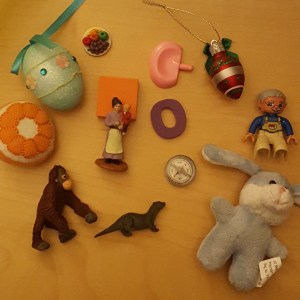
It just so happens that the boys’ Oma & Opa are visiting from the Netherlands! So what better way to start our O week than with these two special words!

Here’s a look at all the objects in my little O box:

20171009_194517.jpg


The words are:

  • das      Obst                          fruit
  • das      Ohr                            ear
  • die       Oma                          grandma
  • der      Opa                          grandfather
  •             orange                      orange (color)
  • die       Orange                     orange (fruit)
  • der      Orang-Utan               orangutan
  • das      Ornament                 ornament
  •             ost                             east
  • das      Osterei                      Easter egg
  • der      Osterhase                 Easter bunny
  • der      Otter                          otter

For the corresponding word cards see the post on Buchstabe der Woche: O.

Buchstabe der Woche: O

This week we’ll be starting our work on the letter O! The words in this unit are:

  • das      Obst                          fruit
  • das      Ohr                            ear
  • die       Oma                          grandma
  • der      Opa                          grandfather
  •             orange                      orange (color)
  • die       Orange                     orange (fruit)
  • der      Orang-Utan               orangutan
  • das      Ornament                 ornament
  •             ost                             east
  • das      Osterei                      Easter egg
  • der      Osterhase                 Easter bunny
  • der      Otter                          otter

I would have liked a little more variety. There are some sets of similar words – Oma & Opa, orange & Orange, Osterei & Osterhase – but sometimes it depends on what objects I can find!

I think I will try to group them by the kind of sound that the O makes.

  1. Oma, Opa
  2. Obst, ost, Osterei, Osterhase, Otter
  3. Ohr, orange, Orange, Orang-Utan, Ornament

Here’s what the cards look like:

This are the all-caps version. You can download the cards below in all-caps or in upper and lower case letters.

I also decided to try creating a backing paper for the cards. Sometimes you can see through the cards, even when I print on cardstock. That doesn’t make for a very good game of memory or go fish! So I created these papers to be printed on the opposite side of the word cards. To be fair, I haven’t tried them myself yet! My print-outs were already laminated. But I’ll try it for sure next time and report back on how it went.

Wortschatz Karten letter backing O-page-001

There has been a lot of activity on the blog recently! But I never hear from my visitors 😦  I would love to hear how you are using the materials! And if you have other ideas, that would be great!

Viel Spaß!

Herbst mit Zahlen und Farben

In story hour yesterday, we celebrated fall with numbers and colors!

I began by using the German blocks that the library has to review numbers 1 through 10.  (You can actually get the German blocks – made by Uncle Goose – on Amazon!)

We read the following books:

  • Zehn Blätter fliegen davon by Anne Möller (2008)
  • Manuel & Didi. Das große Buch der kleinen Mäuseabenteuer (“Die Laubhütte”) by Erwin Moser (2008)
  • Manuel & Didi. Das zweite große Buch der kleinen Mäuseabenteuer (“Der Apfel”) by Erwin Moser (2009)
  • Der Herbst steht auf der Leiter by Peter Hacks (2012)

And we sang the following songs:

  • “Wind” by Nena (Himmel, Sonne, Wind und Regen)
  • “Der Apfelbaum” (Die 30 Besten Spiel- und Bewegungslieder) Click for youtube video
  • “Der Herbst steht auf der Leiter”

You can download the lyrics here: Herbstlieder

Then we did two activities:

The children were given a tree with numbers on it along with 10 foam leaves, also with numbers on each. With help from their mom or caregiver, the children matched the numbers from the stickers with those on the tree and stuck them in the appropriate place. Download the PDF activity here: zehn-blatter-arbeitsblatt-gita

I also gave children a simple Malen nach Zahlen coloring page of a maple leaf and the colors red, orange, and yellow. Download the coloring page here: malen-nach-zahlen-herbstblatt-gita

The older children only needed a little bit of help. And our younger friends enjoyed making their leaves extra colorful!

Der erste Tag in der Montessori-Schule

This is the third year that I am teaching at my kids’ Montessori school. I love being in the Pre-K/Kindergarten class. We usually wait a few weeks before I start, so the children can get settled in their regular routines and work. This year, I’m teaching in the late morning, before lunch. It’s nice that the children then have time to sit and do the coloring page or activity that I bring in.

My first lesson goes something like this:

I greet them with Guten Morgen! I repeat it a number of times and then ask them to repeat it after me.

I tell them my name with Ich heiße…. Then I ask them to tell my their names. I look and point at a student (now I can choose the children who have been in the class in the past years to help demonstrate to the new children) and ask, “Wie heißt du?” I often model for them “Ich heiße ….” Some of the children are not yet ready to speak, and that’s just fine!

I introduce the action words to our Hello Song. (I’ll be posting separately about that soon!) The action words are klatschen, stampfen, & patschen. I show them the large image cards I printed out and laminated, and we say & repeat the words.

We practice the action words, too. I ask them to stay seated to practice stampfen. That’s the trickiest one, because the kids tend to want to keep stomping and even start jumping up and down.

I also teach them ja & nein. Then I show them pictures and ask, “Ist das ‘klatschen’?” for example. I always start with showing the right image. Then I switch it up on them and show them the wrong picture.

Finally, it’s time to sing the song! We always do the actions two times, so I often count: eins, zwei!

I also sing “Meine Finger” from Die 30 Besten Spiel- und Bewegungsliedern, Vol. 3. Instead of the actions in the original song, I repeat the actions from our Hello Song – only klatschen & patschen. Obviously you don’t use your fingers to stomp! (download the text below)

We sing our Goodbye song before I send the children off to do their coloring page. It’s to the same tune as Hoch soll er leben and goes Tschüss mit einander, tschüss miteinander, tschüss, tschüss, tschüss!

Finally I give them a coloring page with images of the actions from the Hello Song and they lyrics. I like the parents to get an idea of what we’re doing in the class, even if they can’t read the German!

You can download the lyrics to “Meine Finger” here: Meine Finger – GitA

Viel Spaß!

Buchstaben and Marble Runs

When Froggy was 4, he discovered marble runs. Who knew there were so many different kinds of marble runs? Plastic, wooden, musical, homemade … the list goes on! We must have at least six different kinds now 🙂  I love them, though. They are fantastic for creativity and problem-solving. And you can play with them for YEARS!! Now Hippo is into them, too.

But what do marble runs have to do with learning German letters??

One set of marbles runs that we love is called Hubelino. (It’s actually made in Germany!) As I was looking for a new set to order when we were in Europe this summer, I discovered that they have made Hubelino even more educational! They now have sets for learning letters, spelling, and numbers. So of course, I had to get my hands on the letter and spelling sets!

Here’s how we used them for the letter B. Froggy needed help sorting through that big pile of letters to get to the sentence at the bottom. Heck, I would have needed help, too! But it was fun!

So Hubelino is a marble run with pieces that are compatible with Duplos. I thought for sure we would have passed on all our Duplos by now (with Froggy age 7 and Hippo age 4), but no way! We need every last one of them for supports! (I’ll have to dig up some photos of the Hubelino constructions the boys have made.)

As you can see, these letter Hubelino pieces don’t really do anything with the marble runs. But the boys love it so much, they are happy to play with them!

I receive no compensation for mentioning Hubelino products.


Buchstabenarbeit – Working with Letters

I’ve been posting about the letter work I’m doing with the boys. (See letter B, letter P, letter M, and letter A.) But what do we do with the objects and cards? Well, there are any number of things you can do! Sometimes I just follow Hippo’s lead and let things happen spontaneously. But here are a few ideas….

We lay out the cards (with image and word) on his little desk. Then he fishes an object out of the bag – nicht anschauen! – and matches the object to the card. And we say the object name. If he doesn’t know it, I might say the beginning sounds, and then he remembers it. And there is plenty of emphasis on the first sound, which is after all what we’re practicing!

I also wrote about my box of letter stickers. Both of the boys love to work with the tiny drawers of stickers. For Froggy, I let him draw a card and spell it in stickers. But for Hippo (who is still just learning his letters in English), I choose some of the shorter words to spell.

Sometimes we play Memory (Memo). Hippo can’t handle too many cards yet. So today we just played with a set of 4 cards. We put out the “control” cards with images and words (and their matching objects) and then turned over the image cards and the word cards. Once we found a match, I asked Hippo what the word card was. We compared it to the “control” card with the word and image to see if the words matched. At first he just said, “yes” to everything. But then he looked more closely. I had him count the letters in the two words, and he saw that they were not the same. Then he really got the idea!

As we played, Hippo then had the idea to line up the matching cards under the “controls”.

These are just a few ideas to get you started! Please comment and let me know what you come up with to do with the letter cards!

Viel Spaß!

Buchstabe: B – Sätze schreiben

Every day, I try to put a note in Froggy’s lunchbox … in German, of course 😉 Sometimes I just write something about his day. But now I’m also working in some of our letter work!

For the letter B, I came up with this crazy sentence:

Der Bauer isst eine Birne und eine Banane im Bus auf dem Weg zum Bären im Baum!

I made up some worksheets based on that sentence to have some more fun with the words.

There is the sentence with images, just the sentence, just images (to cut out and paste onto the sentence page), and just images to write your own crazy sentence!

You can download it for FREE here: B-Satz-GitA

Viel Spaß!